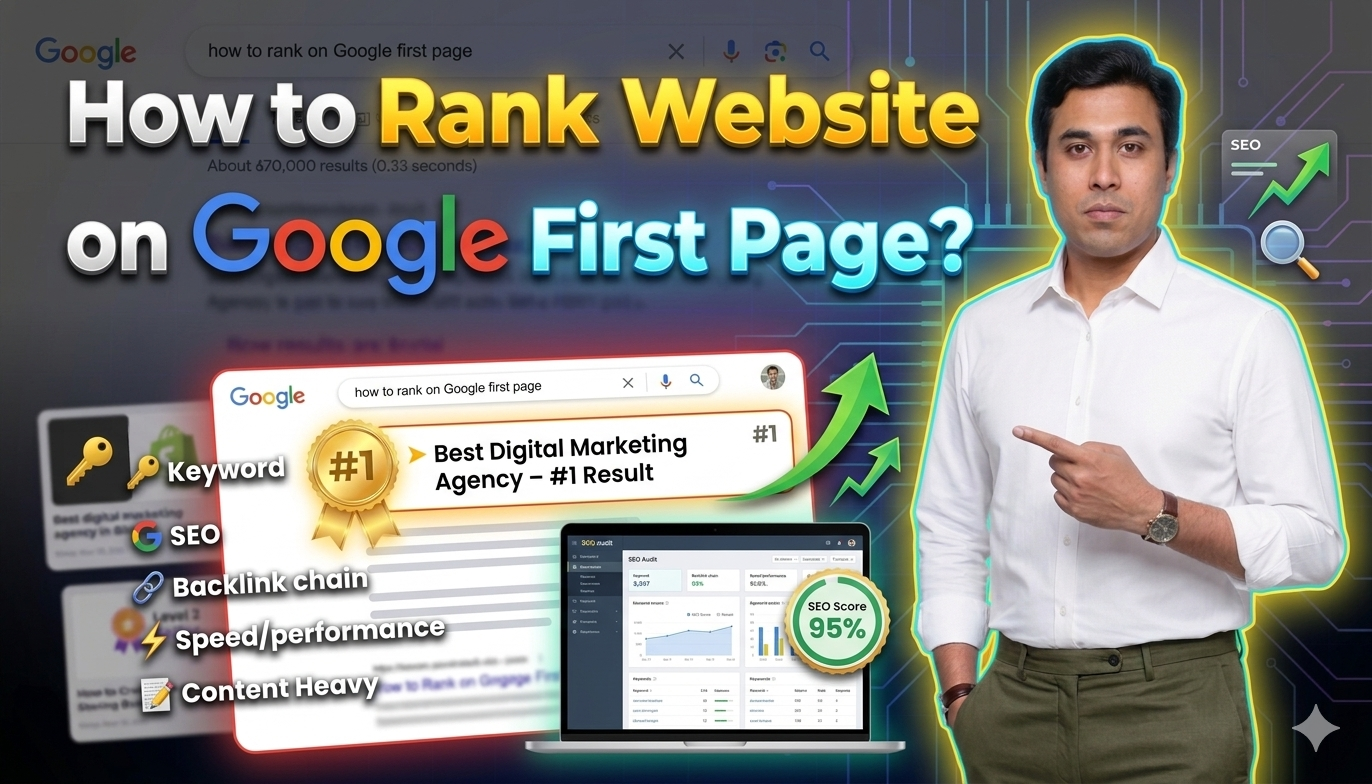
Ranking a website on the first page of Google is not the result of shortcuts, hacks, or temporary tricks—it is the outcome of a well-planned, structured, and consistent SEO strategy. Many people enter the world of SEO expecting quick results, but the reality is that search engines evaluate websites based on multiple layers of signals, including technical performance, content quality, relevance, and authority. If even one of these areas is weak, it can significantly impact your ability to rank.
To truly understand how to rank a website on Google’s first page, you need to shift your mindset from “quick wins” to “long-term systems.” SEO is about building a strong foundation that search engines can trust. This involves optimizing your website so that it becomes easy to crawl, easy to understand, and highly valuable for users. When your website consistently delivers helpful content and maintains strong technical health, Google gradually starts rewarding it with better rankings. The goal is not just to rank once, but to create a system where your website continues to rank for multiple keywords over time.
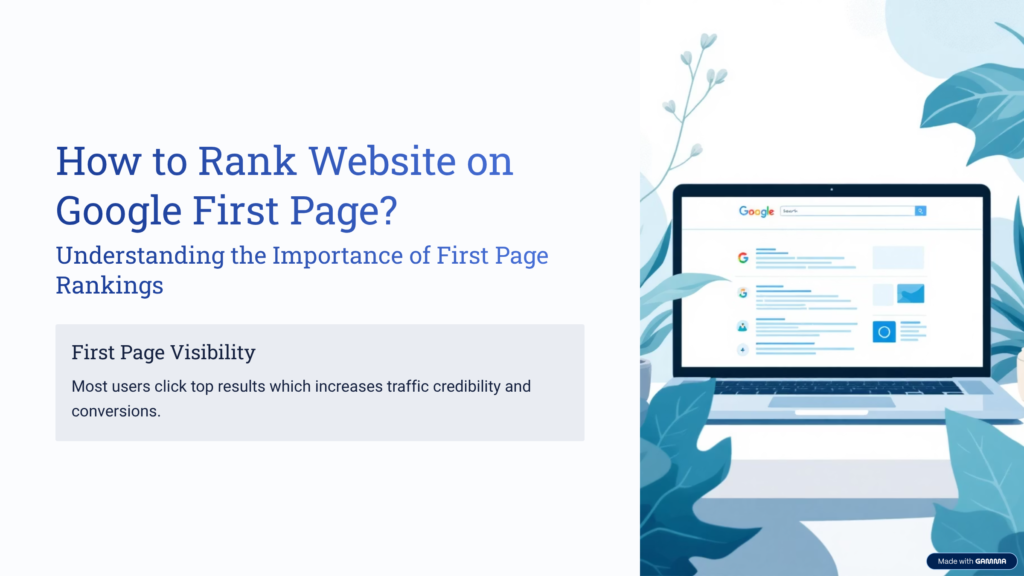
Understanding the Importance of First Page Rankings
The first page of Google holds immense value because that is where the majority of user attention is concentrated. Most users rarely go beyond the first page when searching for information, products, or services. This means that if your website is not on the first page, your chances of getting organic traffic drop significantly, no matter how good your content is.
Ranking on the first page is not just about visibility—it directly impacts traffic, credibility, and conversions. When users see a website consistently appearing in top results, they perceive it as more trustworthy and authoritative. This psychological factor plays a major role in user behavior. Additionally, first-page rankings often lead to higher click-through rates, which further signal to Google that your content is relevant. This creates a positive cycle where better rankings lead to more engagement, and more engagement strengthens your rankings even further.
Step 1: Conduct a Complete Website Audit
Why Website Audit is the First Priority
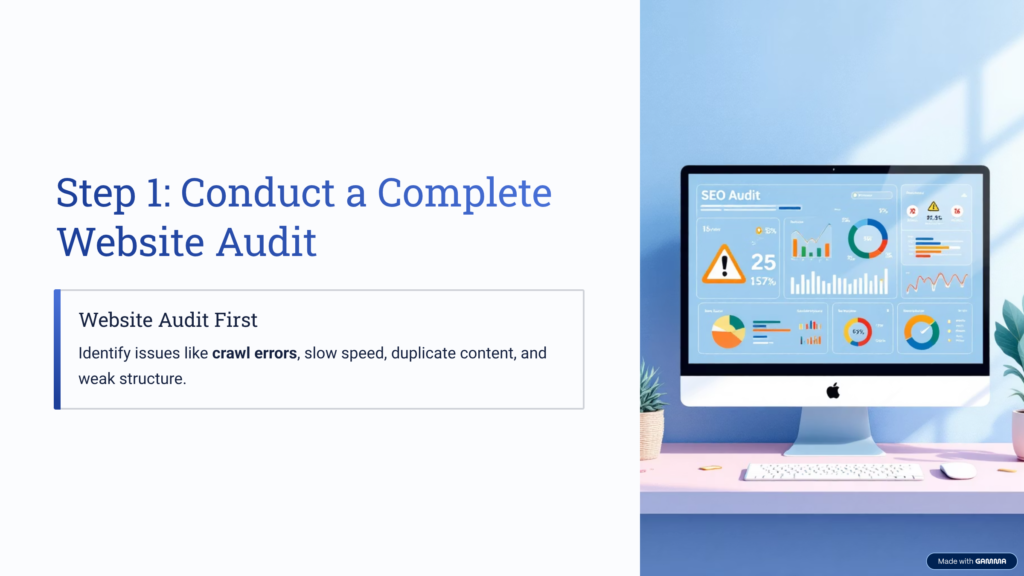
A website audit is the foundation of any successful SEO strategy. Before you start creating content or building backlinks, it is essential to understand the current condition of your website. Without this step, you may unknowingly build your SEO efforts on a weak structure, which can limit your results.
A proper audit helps identify hidden issues that may be affecting your rankings. These issues could include crawl errors, duplicate content, missing metadata, slow loading speed, or improper site structure. Many of these problems are not visible at first glance but can significantly impact how search engines interact with your website. By identifying and addressing these issues early, you create a clean and optimized base that allows all future SEO efforts to perform more effectively.
Fixing Technical SEO Issues
Once the audit is complete, the next step is to fix all technical issues systematically. This process is crucial because technical SEO directly affects how search engines crawl, index, and understand your website. Even the best content cannot perform well if search engines are unable to properly access or interpret it.
Fixing technical issues includes ensuring that every page has a proper title tag and meta description, correcting broken links, optimizing URL structures, and improving page speed. It also involves resolving issues like duplicate content and incorrect heading usage. As these problems are fixed, your website becomes more search-engine-friendly. This not only improves rankings but also enhances user experience, which is another important ranking factor. In many cases, simply fixing technical issues can lead to noticeable improvements in search visibility.
Step 2: Build a Strong Content Strategy with Clustering
Understanding Topic Clustering
Topic clustering is a modern and highly effective SEO strategy that focuses on building authority around a central topic. Instead of targeting random keywords, this approach organizes content into a structured system where a main page (pillar page) is supported by multiple related articles (cluster pages).
This structure helps search engines clearly understand what your website is about. When multiple pages cover different aspects of the same topic and are interconnected, it signals depth and expertise. Google prefers websites that demonstrate comprehensive knowledge rather than those that only cover topics superficially. Topic clustering allows you to establish your website as a reliable source of information within a specific niche, which significantly improves your chances of ranking on the first page.
Creating Cluster-Based Content
Creating cluster-based content requires careful planning and research. You need to identify all relevant subtopics related to your main keyword and create detailed content for each one. These subtopics should address different user intents, such as informational queries, comparisons, and decision-making content.
Each cluster page should provide real value and answer specific questions in detail. At the same time, these pages should be strategically linked back to the pillar page. This internal linking structure strengthens the authority of the main page and improves its ranking potential. As more cluster pages start ranking individually, they collectively boost the visibility of the entire website. Over time, this creates a powerful content ecosystem that supports consistent growth in search rankings.
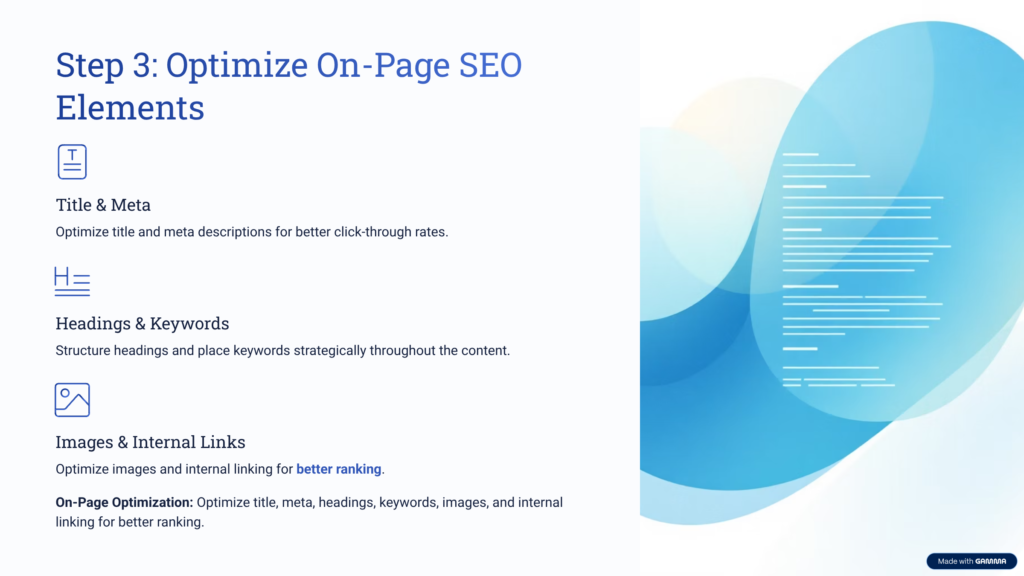
Step 3: Optimize On-Page SEO Elements
Importance of On-Page Optimization
On-page SEO is one of the most important aspects of ranking on Google’s first page. It involves optimizing individual pages so that search engines can clearly understand their content and relevance. Without proper on-page optimization, even high-quality content may fail to rank because search engines cannot accurately interpret it.
On-page SEO ensures that your content is structured, readable, and aligned with user intent. It helps search engines identify the main topic of your page and determine whether it matches a user’s search query. When done correctly, on-page optimization improves both search engine visibility and user experience, creating a strong foundation for higher rankings.
Key On-Page Elements to Focus On
Title and Meta Description
The title and meta description play a crucial role in SEO because they are the first elements that both search engines and users encounter. A well-optimized title should clearly include the target keyword and accurately reflect the content of the page. The meta description should provide a concise summary that encourages users to click.
Heading Structure
A proper heading structure (H1, H2, H3) organizes your content and makes it easier to read. It also helps search engines understand the hierarchy of information on the page. A clear structure improves both SEO performance and user engagement.
Keyword Placement
Keywords should be used naturally throughout the content. They should appear in headings, introductory paragraphs, and key sections without being forced. Proper keyword placement helps search engines identify the relevance of your content.
Internal Linking
Internal links connect different pages within your website. They help distribute authority and guide users to related content. A strong internal linking strategy improves navigation and enhances SEO performance.
Image Optimization
Images should be optimized with descriptive alt text and appropriate file sizes. This improves page speed and provides additional context to search engines, contributing to better rankings.
Step 4: Focus on Quality Backlinks
Importance of Backlinks in SEO
Backlinks are one of the most powerful ranking factors in SEO. They act as endorsements from other websites, signaling to Google that your content is trustworthy and valuable. The more high-quality backlinks your website has, the stronger its authority becomes.
However, not all backlinks are beneficial. Low-quality or spammy links can harm your rankings instead of improving them. This is why it is essential to focus on quality rather than quantity. A few strong backlinks from authoritative websites can have a much greater impact than hundreds of weak links.
Building High-Quality Backlinks
Building high-quality backlinks requires a strategic approach. You need to focus on acquiring links from relevant and reputable sources. These links should be contextually placed within meaningful content rather than appearing forced or unnatural.
Consistency is key in backlink building. Instead of trying to create a large number of links quickly, it is better to build them gradually over time. This approach ensures long-term stability and reduces the risk of penalties. When combined with strong content, quality backlinks significantly improve your chances of ranking on the first page of Google.
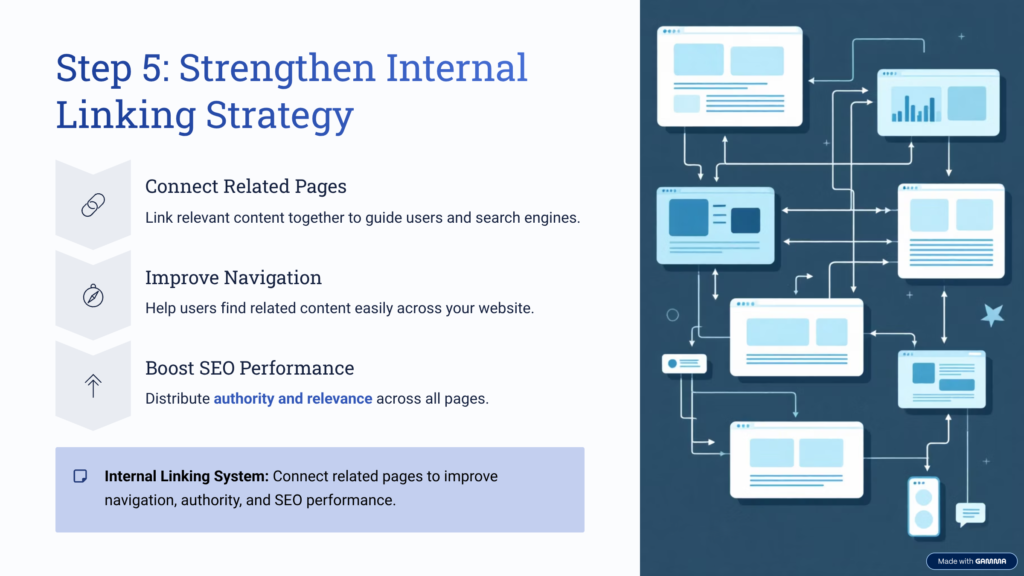
Step 5: Strengthen Internal Linking Strategy
Role of Internal Linking
Internal linking is a powerful yet often underestimated SEO strategy. It helps search engines discover new pages and understand the relationship between different pieces of content. A well-structured internal linking system ensures that important pages receive more attention and authority.
Internal links also improve user experience by guiding visitors to relevant content. This increases the time users spend on your website, which is a positive signal for search engines. A strong internal linking strategy enhances both usability and SEO performance.
Using Anchor Text Effectively
Anchor text plays a crucial role in internal linking. It should be descriptive and relevant to the linked page. Using varied anchor text instead of repeating the same phrase helps maintain a natural link profile.
A balanced approach ensures that your internal links appear organic and effective. This not only improves SEO but also enhances the overall readability and usability of your content.
Step 6: Balance Content and Authority Building
Combining Content and Links
SEO success depends on the balance between high-quality content and strong authority signals. Content provides value to users, while backlinks and internal links enhance credibility and trust.
Focusing only on content without building authority can limit your rankings. Similarly, relying only on backlinks without strong content will not produce sustainable results. A balanced approach ensures that both relevance and authority are achieved, leading to better rankings.
Continuous Content Expansion
Regularly updating and expanding your content is essential for maintaining relevance. Search engines prefer websites that consistently provide fresh and updated information.
Adding new content also creates more opportunities to target additional keywords and attract more traffic. Over time, this continuous expansion strengthens your website’s overall authority and improves its ability to rank on the first page.
Conclusion
Ranking a website on Google’s first page requires a combination of technical optimization, strategic content creation, and authority building. Each step in the SEO process plays a crucial role, and ignoring any one of them can limit your results.
By focusing on website health, implementing topic clustering, optimizing on-page elements, building quality backlinks, and strengthening internal linking, you can create a strong SEO foundation. Consistency and patience are key, as SEO is a long-term process. When executed correctly, this blueprint not only helps you achieve first-page rankings but also ensures sustainable growth and long-term success.

Related Posts