
Welcome to today’s session. In this article, we are going to explain a core concept in on-page SEO: keyword density. You have probably heard that using the right keyword is important. But how often should you use it? That is where keyword density comes in.
Keyword density helps you understand how frequently your target keyword appears in your content. While keywords are essential for SEO, using them correctly is equally important. Overusing or underusing them can affect both rankings and user experience.
What Is Keyword Density?
Keyword density refers to the percentage of times a specific keyword appears in your content compared to the total number of words.
In simple terms, it measures how often your target keyword is used within your article.
Search engines use this as one of the signals to understand the topic of your page. However, it must be used strategically. Simply repeating a keyword many times does not guarantee better rankings.

Why Keyword Density Matters
Keyword density plays a key role in helping Google understand what your page is about. When your keyword appears naturally in your content, it signals relevance.
However, keyword density also affects user experience. If your content sounds repetitive or unnatural, readers may lose interest. This can increase bounce rates and negatively impact your SEO performance.
The goal is to maintain a balance between optimization and readability.
How to Calculate Keyword Density
Calculating keyword density is simple.
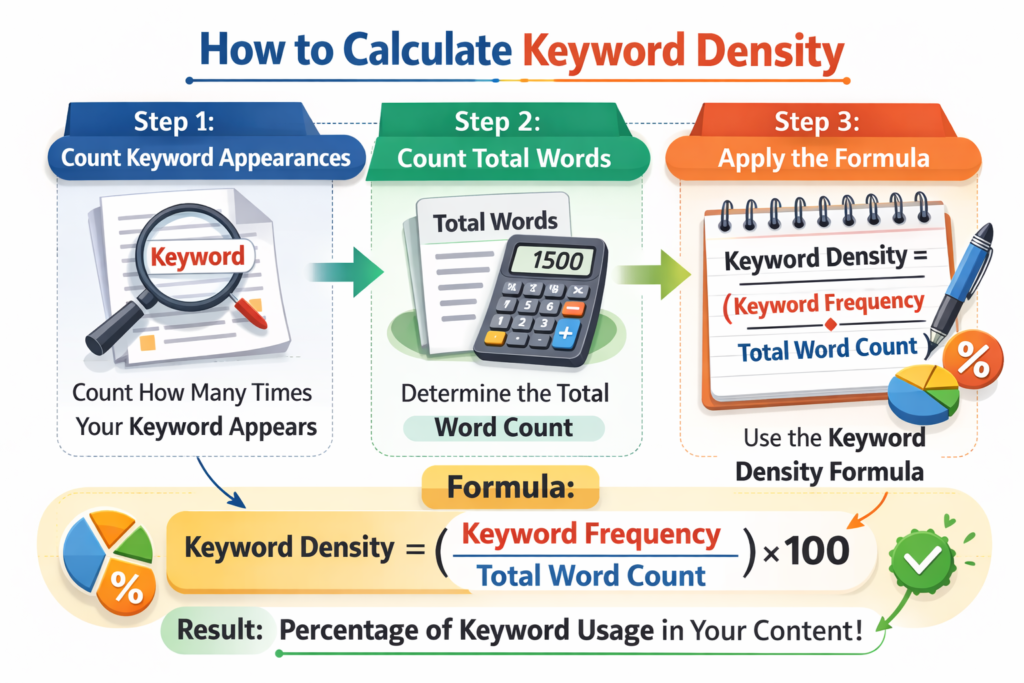
Step 1: Count Keyword Appearances
Identify How Many Times Your Keyword Appears
First, count the number of times your target keyword appears in the content.
Step 2: Count Total Words
Determine the Total Word Count
Next, count the total number of words in your content.
Step 3: Apply the Formula
Use the Keyword Density Formula
Divide the number of times your keyword appears by the total number of words. Then multiply the result by 100.
Formula:
Keyword Density = (Keyword Frequency / Total Word Count) × 100
This gives you the percentage of keyword usage in your content.
What Is the Ideal Keyword Density?
Now comes the important question: what is the ideal keyword density?
Most SEO experts recommend keeping keyword density between 1% and 2%.
This range is considered enough to signal relevance to search engines without making the content feel spammy.
For example, if you have a 1,000-word article, a 1% keyword density means your keyword appears about 10 times. A 2% density would mean about 20 times.
However, these numbers are guidelines, not strict rules. The most important factor is natural usage.
The Risk of Keyword Stuffing
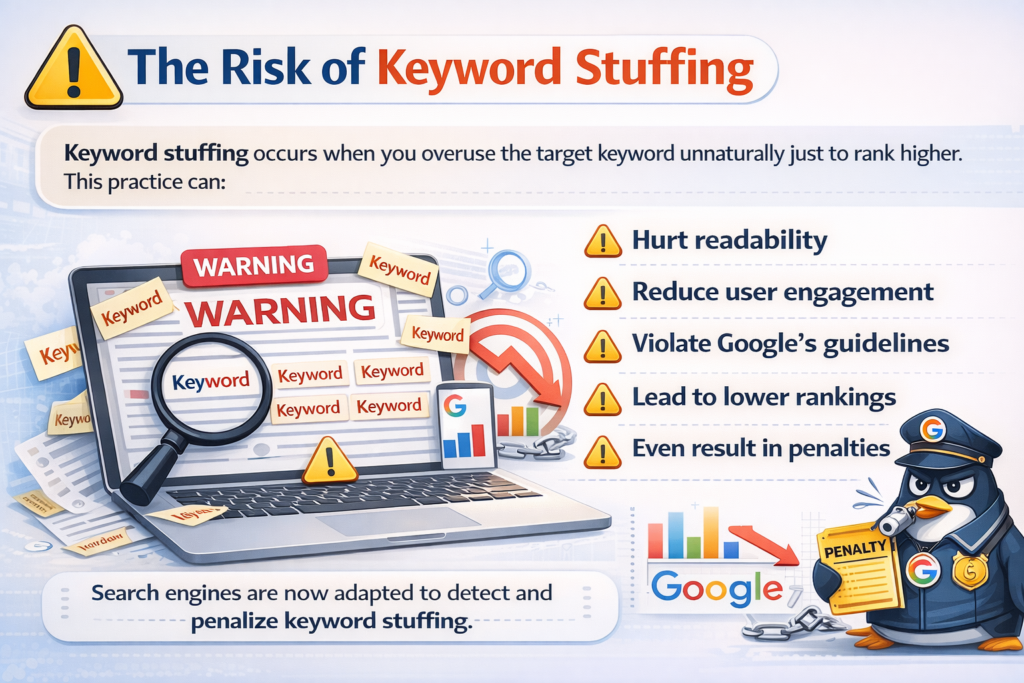
Keyword stuffing occurs when you overuse the target keyword unnaturally just to rank higher.
This practice can:
- Hurt readability
- Reduce user engagement
- Violate Google’s guidelines
- Lead to lower rankings
- Even result in penalties
Search engines are now advanced enough to detect unnatural repetition. Therefore, stuffing keywords is not an effective strategy.
How Keyword Stuffing Affects Rankings
When content is overloaded with keywords:
- It becomes difficult to read
- It sounds unnatural
- It reduces trust
Google prioritizes user experience. If your content appears spammy, it may rank lower.
Instead of focusing on quantity, focus on quality and relevance.
Focus on Semantic SEO
Instead of stuffing keywords, aim for semantic SEO.
Semantic SEO means using your main keyword naturally and supporting it with:
- Synonyms
- Variations
- Related terms
This approach keeps your content rich, engaging, and contextually relevant.
For example, if your main keyword is “digital marketing,” you can also use:
- Online marketing
- Internet marketing
- Digital promotion strategies
This helps search engines understand your topic without overusing a single phrase.
How to Check Keyword Density
You do not have to calculate keyword density manually every time.

Step 1: Use SEO Tools
Analyze Keyword Usage Automatically
There are SEO tools available that scan your content and provide a breakdown of keyword usage.
These tools help you:
- Monitor keyword frequency
- Identify overuse
- Optimize strategically
Step 2: Review Recommendations
Adjust Based on Suggestions
After analyzing your content, adjust your keyword placement if necessary. Remove excessive repetition and ensure natural flow.
SEO tools are helpful, but always prioritize readability.
Practical Example of Keyword Density
Let us consider a practical example.
Suppose you wrote a 1,000-word blog on “digital marketing.”
To keep your keyword density around 1.5%, the term “digital marketing” should appear approximately 10 to 15 times.
These appearances should be spaced naturally throughout the content, including:
Avoid placing them all in one section.
Balancing SEO and User Experience
Keyword density should always be balanced.
Write for your readers first. Focus on clarity, usefulness, and engagement.
Then optimize naturally by including your keyword in:
- Strategic locations
- Relevant sentences
- Logical contexts
If your content reads smoothly and answers user questions effectively, it is more likely to perform well.

Common Mistakes to Avoid
When working with keyword density, avoid the following mistakes:
- Repeating the keyword unnecessarily
- Ignoring synonyms and related terms
- Focusing only on numbers instead of quality
- Sacrificing readability for optimization
SEO is not about manipulating search engines. It is about creating valuable content that meets user needs.
The Role of Keyword Placement
Keyword density is important, but placement matters as well.
Your target keyword should appear in:
- The page title
- The meta description
- The main heading
- Subheadings where relevant
- The introduction
- The conclusion
Strategic placement strengthens relevance without increasing density unnaturally.
Monitoring and Improving Over Time
SEO is not a one-time task. Monitor your content regularly.
Use SEO tools to:
- Track performance
- Analyze keyword usage
- Identify improvements
If your rankings drop, review your content to ensure it remains optimized and relevant.
Final Summary: Using Keyword Density Wisely
To summarize, keyword density tells search engines what your content is about. It is an important element of on-page SEO.
However, it should always be balanced.
Keep keyword density between 1% and 2% as a general guideline. Avoid keyword stuffing and focus on semantic SEO. Use synonyms and related terms to enrich your content.
Write for your readers first. Optimize naturally and monitor your keyword usage using SEO tools.
When used correctly, keyword density strengthens your content without harming readability or user experience.

Related Posts