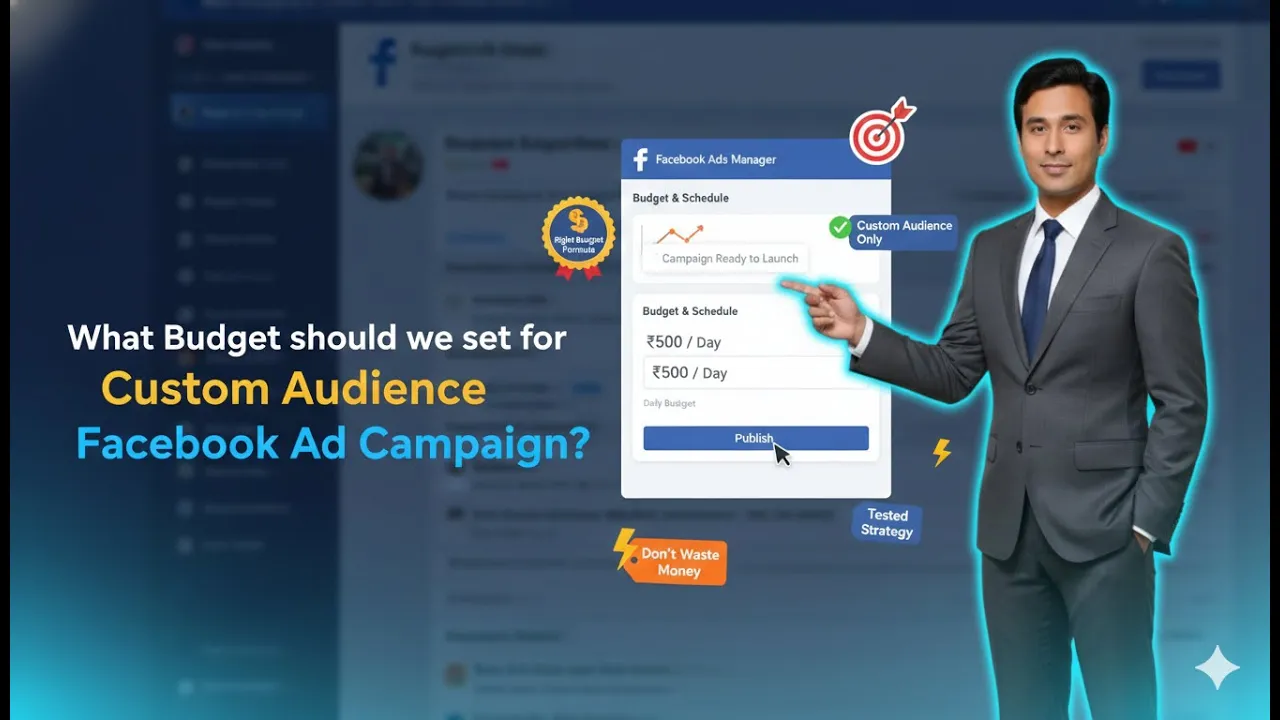
One of the most commonly asked questions by students and advertisers is about the daily budget for Facebook ads when running campaigns on a custom audience. Many people understand how to create a custom audience, but they are often confused about how much budget should be allocated to campaigns targeting that audience.
In this article, we will clearly explain how to decide the daily budget for Facebook ads that are running on a custom audience. This explanation is based entirely on practical experience and real campaign behavior, and it focuses on why there is no fixed budget rule and how budget should be planned logically.
Why There Is No Fixed Daily Budget for Custom Audience Ads
The first and most important point to understand is that there is no fixed daily budget that can be universally suggested for Facebook ads running on a custom audience.
The main reason for this is that every advertiser has a different custom audience size. Since the size of a custom audience varies from account to account, it becomes impossible to recommend a single daily budget that works for everyone.
Without knowing the actual audience size, suggesting a fixed daily budget would be incorrect and misleading.
Importance of Custom Audience Size in Budget Planning
Why Audience Size Matters
The daily budget for a custom audience campaign depends directly on how large or small that audience is. If the audience size is small, a high daily budget can cause problems such as high ad frequency and budget waste.
On the other hand, if the audience size is large, a higher budget may be required to deliver ads effectively.
Because audience size differs for every advertiser, budget decisions must always be audience-based.
Understanding the Relationship Between Saved Audience and Custom Audience
Before running ads on a custom audience, advertisers usually run campaigns on a saved audience.
A saved audience typically targets a general or broad group of people based on interests, demographics, or behavior. From this saved audience campaign, data is collected, which is later used to create a custom audience.
This relationship between saved audience campaigns and custom audience campaigns plays a key role in deciding the budget.
Step 1: Start With a Saved Audience Campaign
Build Data Before Running Custom Audience Ads
When you start advertising, the first campaign is usually run on a saved audience. This campaign helps in collecting data such as website visitors, ad interactions, or conversions.
For example, you may be spending a certain daily budget on a saved audience campaign to generate traffic or engagement. This campaign becomes the foundation for creating a custom audience later.

Step 2: Create a Custom Audience From the First Campaign
Use Data Generated From Saved Audience
Once the saved audience campaign starts generating enough data, a custom audience can be created from that data.
This custom audience is derived from people who interacted with the first campaign. At this stage, a second campaign is launched that targets this newly created custom audience.

Recommended Budget Strategy for Custom Audience Campaigns
The 5% Budget Rule Explained
When running a second campaign on a custom audience that is created from a saved audience campaign, a practical rule can be followed.
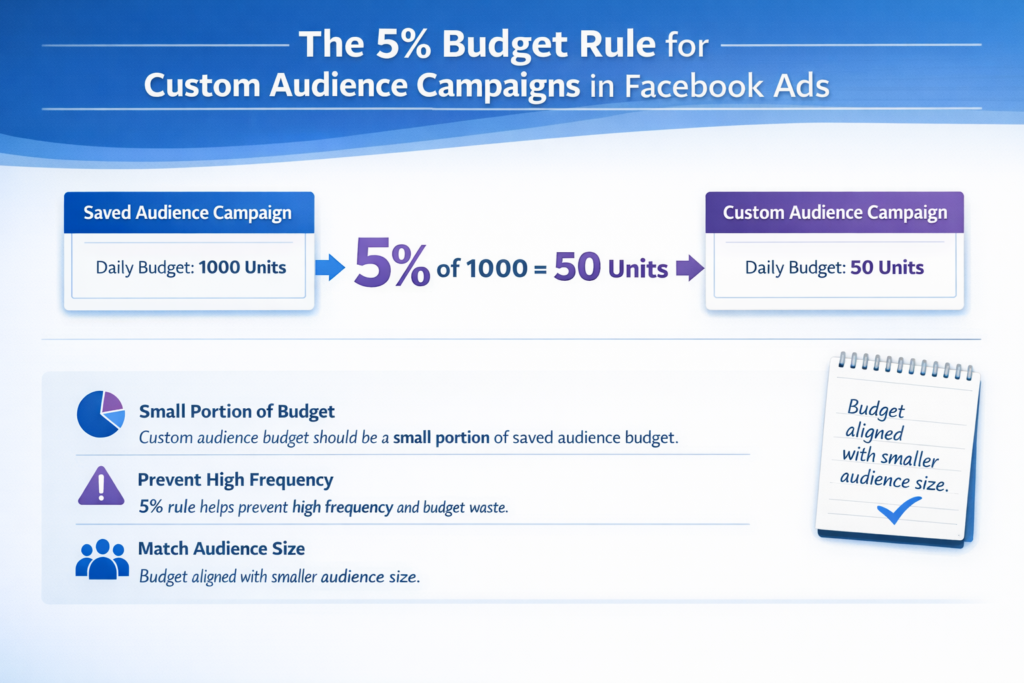
The suggested approach is to keep the daily budget of the custom audience campaign at 5% of the daily budget of the saved audience campaign.
This strategy helps maintain balance between the two campaigns and prevents budget waste.
Step 3: Apply the 5% Budget Rule
Compare With Saved Audience Campaign Budget
For example, if the saved audience campaign has a daily budget of 1,000 units, then the custom audience campaign should initially have a daily budget of 5% of that amount.
That means the custom audience campaign would start with a daily budget of 50 units.
This approach ensures that the budget aligns with the smaller size of the custom audience.
Understanding Platform Minimum Budget Requirements
Minimum Daily Budget Depends on Currency
Although the 5% rule gives a logical budget estimate, it is important to understand that Facebook has its own minimum budget requirements.
The minimum daily budget depends on the currency and country. This means the calculated 5% budget may sometimes fall below the allowed minimum.
Step 4: Adjust Budget Based on Minimum Allowed Limit
Follow the Platform’s Minimum Budget Rule
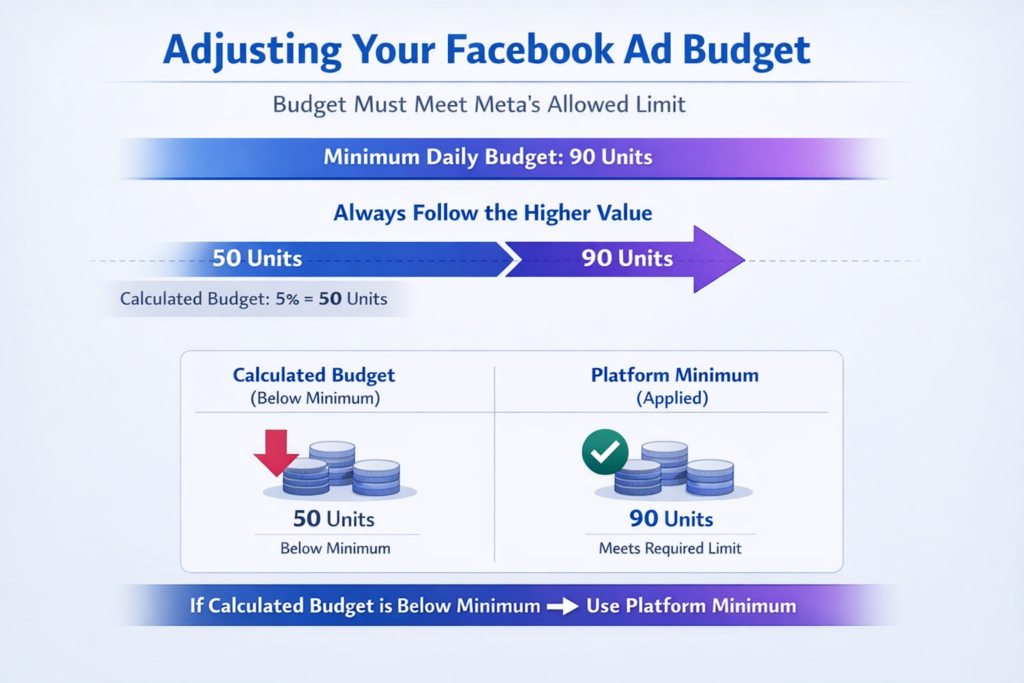
If the calculated budget is lower than the platform’s minimum daily budget, then you must follow the minimum limit instead.
For example, in India, the minimum daily budget is around 90 units. So even if 5% of your saved audience campaign budget is lower than this amount, you must set the daily budget to the minimum allowed value.
Choosing Between Minimum Budget and 5% Rule
At this stage, advertisers have two practical options:
- Set the daily budget at the platform’s minimum allowed amount
- Or set the budget at 5% of the saved audience campaign budget, whichever is higher
Both approaches are acceptable as long as the budget aligns with audience size and delivery behavior.
Running Two Campaigns Simultaneously
Saved Audience and Custom Audience Together
When following this strategy, two campaigns are running at the same time:
- One campaign targets the saved audience
- The second campaign targets the custom audience
As time passes, the saved audience campaign continues to generate new data. This automatically increases the size of the custom audience.
Step 5: Monitor Custom Audience Growth
Observe Audience Size Increase Over Time
As days go by, more users interact with the saved audience campaign. These users are added to the custom audience.
Because of this, the custom audience size keeps increasing gradually. This growth creates an opportunity to scale the custom audience campaign budget.

Gradually Increasing Budget for Custom Audience Campaigns
Why Gradual Scaling Is Important
Increasing the budget too quickly can cause delivery issues and sudden frequency spikes. Gradual scaling ensures stable performance and controlled ad delivery.
The budget should be increased only when the custom audience size has grown enough to handle higher spend.
Step 6: Increase Budget Step by Step
Weekly or Bi-Weekly Budget Scaling
A gradual approach can be followed, such as:
- Increasing the daily budget to around 100 units after one week
- Increasing it further to around 150 units after two weeks
This increase should always correspond with the growth of the custom audience size.

Managing Ad Frequency in Custom Audience Campaigns
Understanding Frequency Impact
Ad Frequency refers to how many times the same user sees your ad. When running ads on a custom audience, frequency increases faster compared to saved audiences because the audience is smaller.
High frequency can lead to ad fatigue and poor performance.
Step 7: Maintain Optimal Frequency Levels
Keep Frequency Between 3 to 5
The goal should be to keep the ad frequency between three to five times for the custom audience.
Maintaining this range ensures that:
- Ads remain effective
- Users do not get irritated
- Budget is spent efficiently
The daily budget should always be adjusted to maintain this frequency range.

What Happens If Budget Is Too High for Custom Audience
If the daily budget is too high compared to audience size:
- Ads are shown repeatedly to the same users
- Frequency increases rapidly
- Budget gets wasted
- Campaign performance declines
This is why budget control is critical when running custom audience campaigns.
Why Budget Should Increase With Audience Size
As the custom audience size grows day by day, the campaign can safely handle more budget.
Increasing the budget in proportion to audience growth allows:
- Better reach
- Stable frequency
- Improved performance
Budget scaling should always follow audience expansion, not the other way around.
Final Budget Planning Recommendation
There is no single daily budget that fits all custom audience campaigns. Budget decisions should be based on:
- Custom audience size
- Saved audience campaign budget
- Platform minimum budget limits
- Frequency levels
Following a structured and gradual approach helps avoid common mistakes.
Final Conclusion
When running Facebook ads on a custom audience, budget planning should always be data-driven and audience-focused. Since custom audience sizes vary, there is no fixed daily budget that can be recommended for everyone.
A practical approach is to start with around 5% of the saved audience campaign budget or the platform’s minimum allowed budget, whichever is higher. As the custom audience size grows, the budget should be increased gradually while maintaining a healthy frequency range of three to five.
By following this method, advertisers can avoid budget waste, control frequency, and achieve better performance from their custom audience campaigns.

Related Posts