
Welcome to this article. Today, we are going to explain an essential metric in SEO: CTR, or click-through rate. Whether you are running blogs, product pages, or service sites, CTR tells you how effective your listings are in search engines.
You may already be working on keyword research, content optimization, and backlink building. However, if users are not clicking on your page in search results, your SEO performance will remain limited. That is why CTR is such an important metric.
Let us break it down step by step.
What Is CTR?
CTR stands for click-through rate. It measures the percentage of users who clicked on your link after seeing it in search results.
In simple terms, CTR tells you how many people chose your result compared to how many people saw it.
For example, if your page appears 1,000 times in search results and 100 users click on it, your CTR would be 10%.

A higher CTR means more people are interested in your listing.
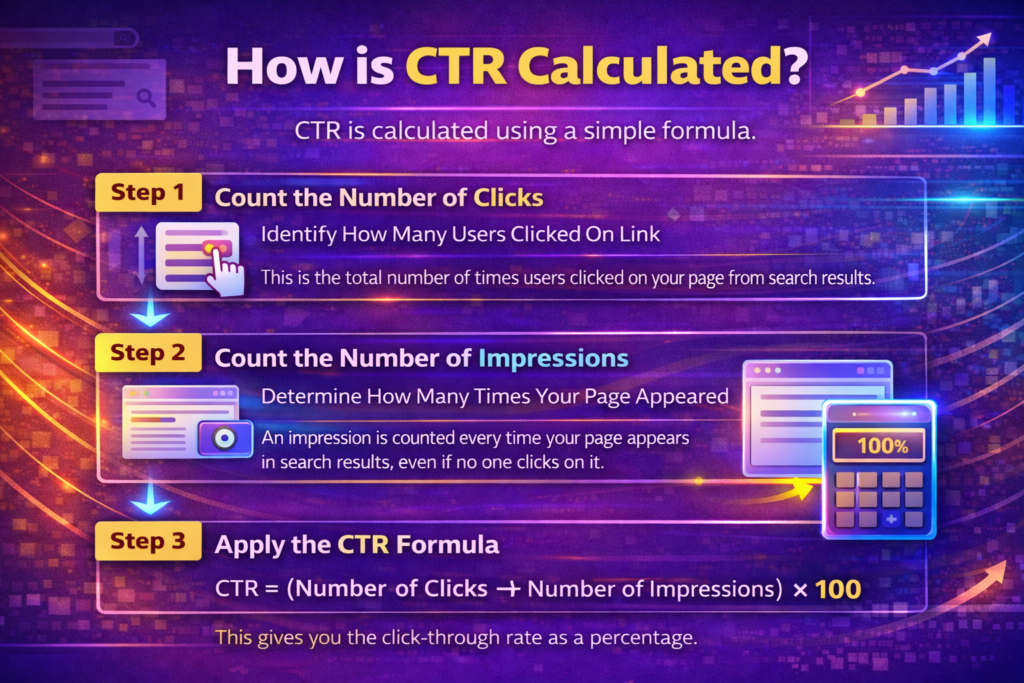
How Is CTR Calculated?
CTR is calculated using a simple formula.
Step 1: Count the Number of Clicks
Identify How Many Users Clicked on Your Link
This is the total number of times users clicked on your page from search results.
Step 2: Count the Number of Impressions
Determine How Many Times Your Page Appeared
An impression is counted every time your page appears in search results, even if no one clicks on it.
Step 3: Apply the CTR Formula
Use the Calculation Formula
CTR = (Number of Clicks ÷ Number of Impressions) × 100
This gives you the click-through rate as a percentage.
Why CTR Is Important in SEO
CTR is more than just a number. It is a signal.
Google uses CTR as an indicator of how relevant and appealing your page is to users. If many users click on your listing compared to others at the same position, it suggests that your content matches user intent.
If your CTR is high, it may improve your ranking over time.
Search engines aim to deliver results that users prefer. A higher CTR indicates that users find your result attractive and useful.
How CTR Impacts Rankings
While CTR is not the only ranking factor, it plays an important role in overall performance.
If two pages rank similarly and one consistently receives more clicks, it signals that users prefer that page. Over time, this may positively influence rankings.
However, CTR works alongside other factors such as:
- Content quality
- Keyword relevance
- Page speed
- Backlinks
CTR supports SEO efforts by increasing engagement.
Factors That Influence CTR
Several factors influence your CTR, and most of them relate to how your content appears in search results.
Let us go over the most important ones.
Title Tag
Importance of a Compelling Title
Your title tag is the first thing users see in search results. A clear, attractive, and relevant title increases the likelihood of clicks.
Using:
- Power words
- Numbers
- Questions
can make your title more engaging.
Meta Description
Writing an Engaging Description
Although meta descriptions do not directly affect rankings, they significantly influence CTR.
A well-written meta description:
- Explains what the page offers
- Matches user intent
- Encourages action
If your description is boring or unclear, users may skip your listing.
Search Ranking Position
The Impact of Position on CTR
CTR benchmarks vary by industry and keyword type. However, on average:
- Top three positions may see CTR between 10% to 30%.
- Positions four to ten might get 1% to 5%.
The higher your ranking, the more visibility you get, and the higher your potential CTR.
Rich Snippets and Schema Markup
Enhancing Search Appearance
Adding schema markup can trigger rich results such as:
- Star ratings
- FAQs
- Product details
- Breadcrumbs
These enhanced listings stand out visually and can significantly improve CTR.
Practical Example of CTR Impact
Let us look at a quick example.
Both pages rank for “best budget phones.”
One has a boring title like:
“Cheap Phone List”
The other says:
“Top 10 Budget Smartphones Under 10,000”
Which one would you click?
Most users would choose the second option because it is specific, engaging, and clear.
This example shows how title optimization directly impacts CTR.
How to Improve Your CTR
Improving CTR requires deliberate optimization.

Step 1: Write Compelling Titles
Use Engaging Language
Include numbers, questions, and power words in your titles to make them more clickable.
Step 2: Optimize Meta Descriptions
Match User Intent
Ensure your meta description clearly answers what the user is searching for.
Step 3: Improve Your Ranking
Focus on Overall SEO
Higher rankings naturally increase CTR. Improve your SEO through:
- Quality content
- Technical optimization
- Backlink building
Step 4: Use Schema Markup
Enable Rich Results
Add structured data to enhance your search listings and attract attention.
How to Monitor Your CTR
Monitoring your CTR is essential for continuous improvement.
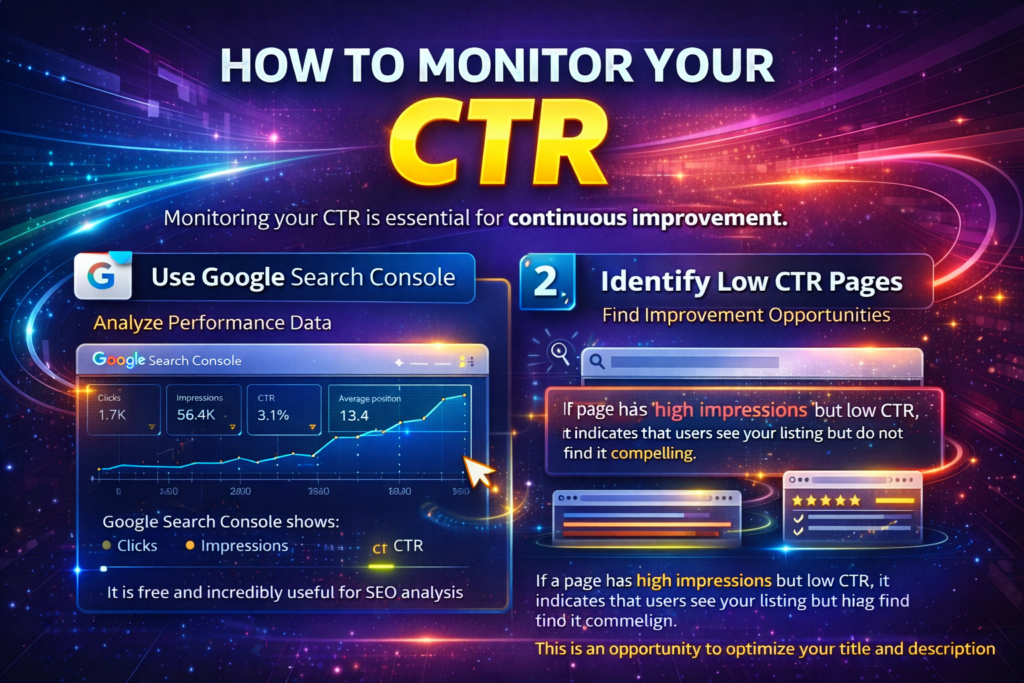
Step 1: Use Google Search Console
Analyze Performance Data
Google Search Console shows:
- Clicks
- Impressions
- CTR
- Average position
It is free and incredibly useful for SEO analysis.
Step 2: Identify Low CTR Pages
Find Improvement Opportunities
If a page has high impressions but low CTR, it indicates that users see your listing but do not find it compelling.
This is an opportunity to optimize your title and description.
Understanding CTR Benchmarks
CTR benchmarks are not fixed. They depend on:
- Industry
- Keyword competition
- Search intent
- Device type
For example:
- Informational keywords may have different CTR patterns than transactional keywords.
- Branded searches often have higher CTR because users are specifically looking for that brand.
Always compare your performance within your niche.
Common Mistakes to Avoid
When working on CTR, avoid these mistakes:
- Ignoring title optimization
- Writing vague meta descriptions
- Overusing clickbait titles that mislead users
- Focusing only on impressions and ignoring CTR
A misleading title may increase clicks temporarily but can harm engagement and trust.
Balancing CTR and User Experience
While improving CTR is important, it should not come at the cost of user experience.
Your title and description must accurately represent your content. If users click and do not find what they expect, they will leave quickly.
This can increase bounce rate and negatively impact performance.
Always ensure that:
- Your content matches your snippet
- Your page delivers value
- Your titles are honest and clear
Final Summary: The Importance of CTR in SEO
To summarize, CTR is a key performance indicator in SEO. It tells you how many users are clicking on your page after seeing it in search results.
It is calculated by dividing clicks by impressions and multiplying by 100.
The better your titles, descriptions, and ranking, the higher your CTR.
CTR reflects how appealing and relevant your listing appears to users. By optimizing your titles, improving your meta descriptions, using schema markup, and monitoring performance through tools like Google Search Console, you can steadily improve your click-through rate.
In SEO, visibility is important. But clicks are what drive traffic. And CTR is the metric that connects visibility to real user engagement.

Related Posts