Hello viewers, in this article we are going to understand in detail what CPM means in Facebook ads. While running Facebook or Meta ad campaigns, advertisers often come across multiple performance metrics inside Meta Ads Manager. These metrics help us analyze how our ads are performing and where our money is being spent. One such important metric that appears during ad campaign analysis is CPM.
To understand CPM properly, it is important to first look at where it appears and why it matters in Facebook ad reporting.
Understanding Where CPM Appears in Ads Manager
Viewing Campaign Results in Meta Ads Manager
As shown in the Ads Manager interface, multiple ad campaigns have been run recently. When we scroll towards the right side of the Ads Manager dashboard, we can see different performance results related to these ad campaigns.
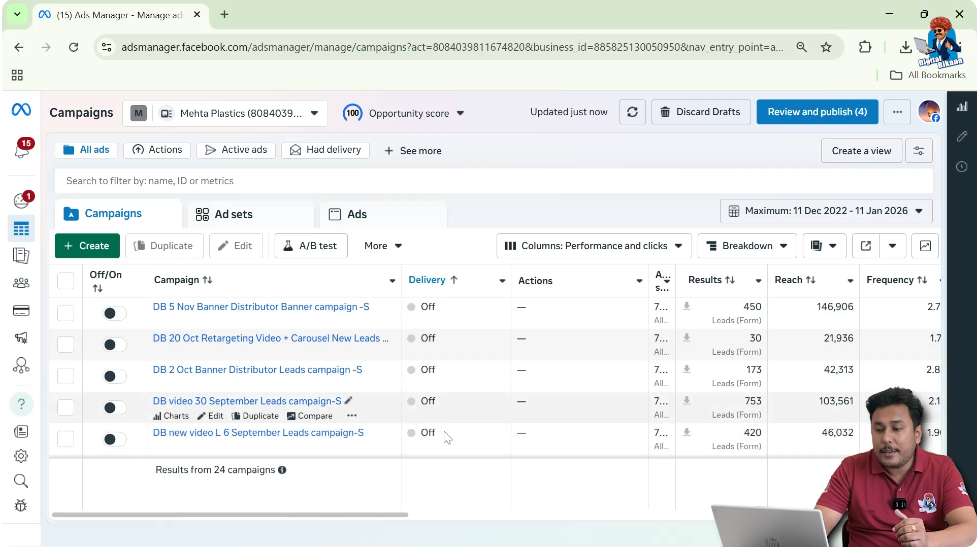
During this analysis process, Meta displays several metrics such as reach, impressions, amount spent, and CPM. Among these metrics, CPM is one of the most important indicators related to ad visibility and cost.

What Is CPM?
Full Form of CPM
The full form of CPM is Cost Per Mille.
“Mille” means one thousand. Therefore, CPM refers to the cost per 1,000 impressions.
What Does Cost Per Mille Mean?
CPM represents how much Meta charges an advertiser for showing an advertisement 1,000 times.
It is important to understand that CPM:
- Is not cost per 1,000 people
- Is not cost per 1,000 users
- Is only cost per 1,000 impressions
An impression simply means the number of times an ad is displayed on a user’s screen.
Understanding Impressions in Facebook Ads
What Is an Impression?
An impression occurs every time an ad is shown to a user on Meta platforms such as Facebook or Instagram.
If the same user sees the same ad multiple times, each appearance is counted as a separate impression.
Example Data from Ads Manager
To understand impressions clearly, let us analyze the data shown in the Ads Manager.
Amount Spent on the Ad Campaign
In the given example:
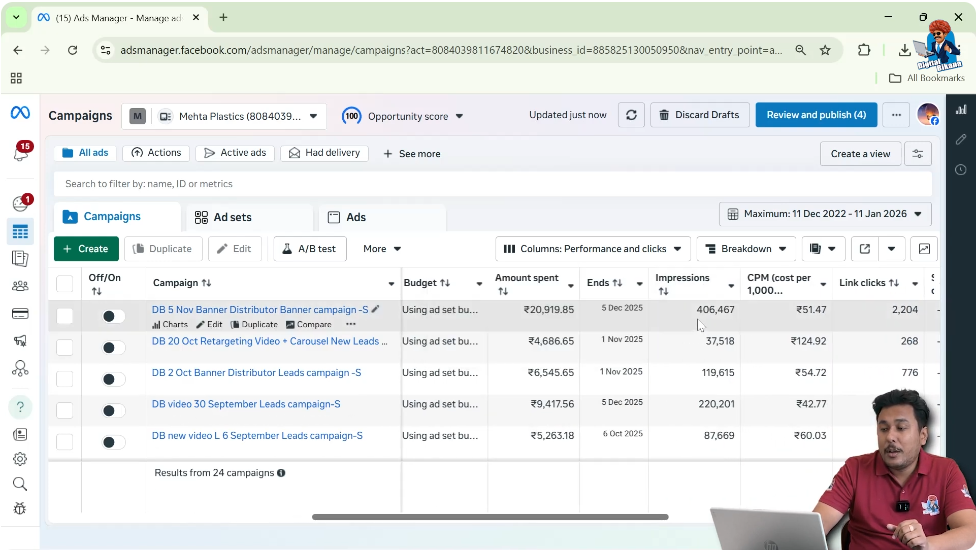
- Around ₹20,000 has been spent on a Facebook ad campaign.

Reach of the Ad Campaign
Against this ad spend:
- The campaign reached approximately 1,46,000 users
This means that 1,46,000 unique people have seen the advertisement at least once.

Total Impressions of the Ad Campaign
Meta has shown the same ad:
- 4,06,000 times
This means the ad was displayed multiple times to the same users.
Difference Between Reach and Impressions
Reach Explained
- Reach refers to the number of unique users
- In this example, reach is 1,46,000 users
Impressions Explained
- Impressions refer to the total number of times the ad was shown
- In this example, impressions are 4,06,000 times
This clearly shows that:
- One user may see the same ad more than once
- Each display counts as a separate impression
Why CPM Is Based on Impressions, Not Reach
CPM is calculated based on impressions, not reach.
This means:
- Meta charges advertisers based on how many times an ad is shown
- It does not matter whether the ad is shown to new users or repeat users
CPM answers the question:
How much did Meta charge to show the ad 1,000 times?
Understanding CPM in Simple Terms
CPM tells us:
- How expensive or affordable it is to get visibility
- The cost of showing an ad repeatedly to users
If CPM is lower:
- Ads are being shown more cheaply
If CPM is higher:
- Ads are costing more to be displayed
How Meta Calculates CPM
Meta automatically calculates CPM using the total amount spent and total impressions.
However, it is also possible to calculate CPM manually to understand the metric better.
Step-by-Step Manual Calculation of CPM
Step 1: Identify Total Amount Spent
In this example:
- Total ad spend is approximately ₹20,000
Step 2: Identify Total Impressions
- Total impressions shown by Meta are 4,06,467
Step 3: Calculate Cost of One Impression
To calculate the cost of one impression:
- Divide the amount spent by the number of impressions
This calculation shows how much one impression costs.
Step 4: Calculate Cost of 1,000 Impressions
To calculate CPM:
- Multiply the cost of one impression by 1,000
After calculation:
- CPM comes out to be approximately ₹51.46
What Does ₹51.46 CPM Mean?
A CPM of ₹51.46 means:
- Meta charged around ₹51.46 to show the ad 1,000 times
This value represents the cost of visibility, not engagement, clicks, or conversions.
Important Clarification About CPM
CPM Does Not Indicate Clicks
CPM does not tell:
- How many people clicked on the ad
- How many people filled a form
- How many people converted
It only indicates:
- The cost of displaying the ad
CPM Is Independent of User Action
Even if:
- Users do not click the ad
- Users do not interact with the ad
CPM is still counted as long as the ad is shown.
Why CPM Is Important in Ad Campaign Analysis
CPM helps advertisers understand:
- How competitive the ad placement is
- How costly it is to get visibility on Meta platforms
A high CPM may indicate:
- High competition
- Broad targeting
- Premium placements
A low CPM may indicate:
- Efficient ad delivery
- Less competition
CPM vs User Views
In this campaign:
- Number of users: 1,46,000
- Number of impressions: 4,06,000
This shows that:
- Users saw the ad multiple times
- CPM measures cost for repeated visibility
CPM Is About Frequency, Not Uniqueness
Because impressions include repeated views:
- CPM includes frequency
- The same user seeing the ad again increases impressions
This is why CPM focuses on impressions instead of reach.
How CPM Appears in Meta Ads Manager
In Meta Ads Manager:
- CPM is displayed as Cost per 1,000 Impressions
- It is calculated automatically by Meta
- Advertisers can view it directly in the campaign results
Final Understanding of CPM in Facebook Ads
CPM stands for Cost Per Mille, which means cost per 1,000 impressions.
From the given ad campaign:
- ₹20,000 spent
- 1,46,000 users reached
- 4,06,000 impressions delivered
- CPM calculated as approximately ₹51.46
This means Meta charged ₹51.46 to display the ad 1,000 times.
Conclusion
CPM is a visibility-based metric that helps advertisers understand how much they are paying to show their ads on Meta platforms. It does not measure clicks, leads, or conversions. Instead, it focuses purely on how often an ad appears on users’ screens.
By understanding CPM clearly, advertisers can analyze ad delivery costs and make informed decisions while reviewing Facebook ad campaign performance.

Related Posts