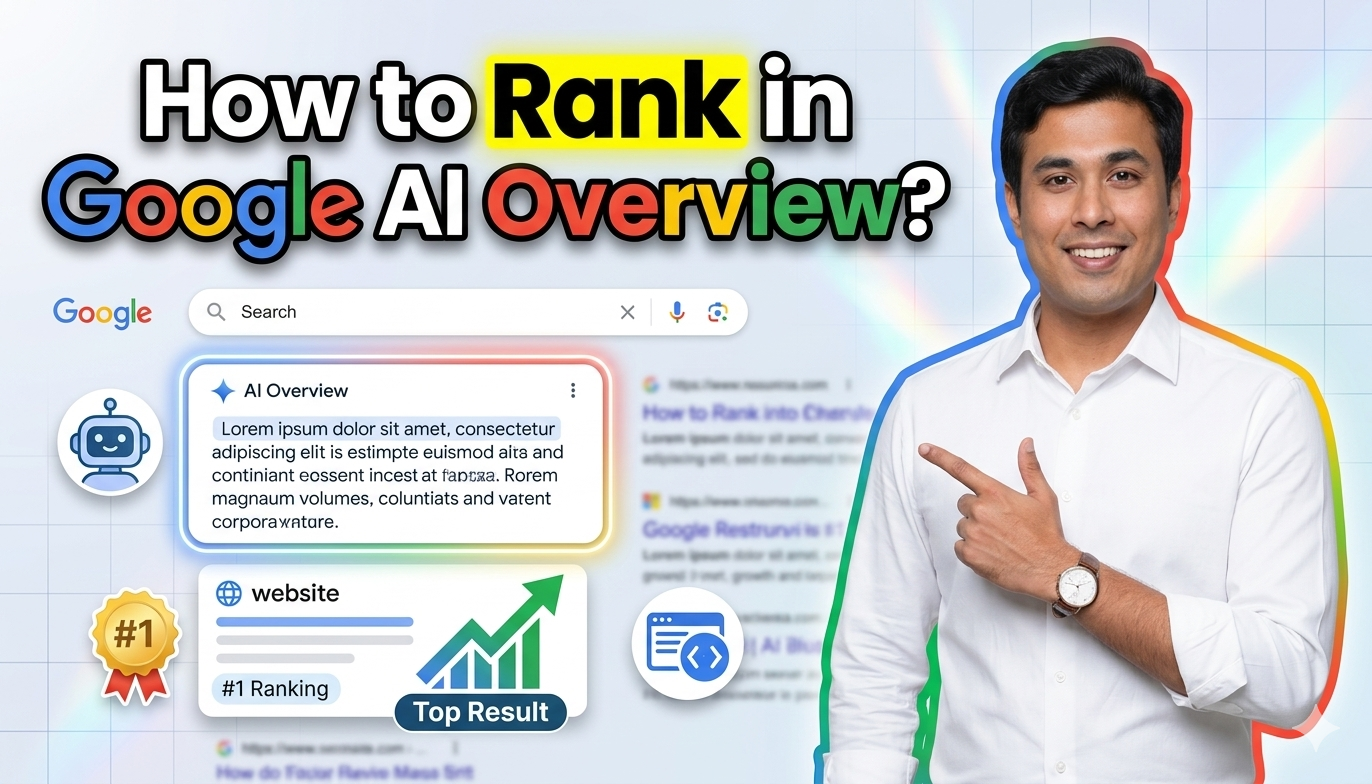
The way people interact with search engines has changed significantly, and this transformation has directly impacted how websites gain visibility. Earlier, users would type a query and receive a list of links, from which they would choose a website to visit. However, now search engines are increasingly focused on delivering direct answers through AI-generated summaries. This shift has introduced a powerful feature known as Google AI Overview, which appears at the top of search results and provides a consolidated answer by analyzing multiple sources.
This evolution has fundamentally altered the concept of SEO. Instead of competing only for traditional rankings, websites now need to compete for visibility within AI-generated responses. These responses often satisfy user intent instantly, reducing the need to click on individual links. As a result, many searches are becoming zero-click searches, where users get the information they need without leaving the search results page.
To succeed in this new environment, it is essential to understand how AI Overview works, what factors influence visibility within it, and how content should be structured to align with AI-driven algorithms. This article explores every aspect of ranking in Google AI Overview in a detailed and structured manner.
Understanding Google AI Overview in Depth
What is Google AI Overview?
Google AI Overview is an advanced feature that uses artificial intelligence to generate summarized answers to user queries. Instead of simply listing web pages, the search engine scans a large number of sources, extracts relevant information, and presents it in a structured and easy-to-understand format at the top of the search results.
This summary is not created randomly. It is based on data collected from multiple websites, and each piece of information included in the overview is supported by citations. These citations are essentially references to the sources from which the information has been derived. For websites, being included as a citation means gaining visibility directly within the most prominent section of the search results page.
The importance of this feature lies in its placement. Since it appears above traditional results, it captures the maximum attention of users. This makes it one of the most valuable positions in search, even more impactful than ranking first in organic results.
How AI Overview Generates Answers
AI Overview works by analyzing user queries and understanding their intent at a deeper level. Instead of matching keywords alone, it interprets what the user is actually trying to learn or achieve. Once the intent is understood, the system scans hundreds of web pages to find relevant information.
After gathering data, it organizes the information into a coherent response. Different sections of the answer may be derived from different sources, and each section is linked to a citation. This means that a single AI Overview response can include references from multiple websites, each contributing a specific part of the answer.
This process highlights an important factor: ranking in AI Overview is not about having a single comprehensive page alone. It is about providing specific, high-quality information that can be used as a reliable reference for a particular part of a query.
The Rise of Zero-Click Searches
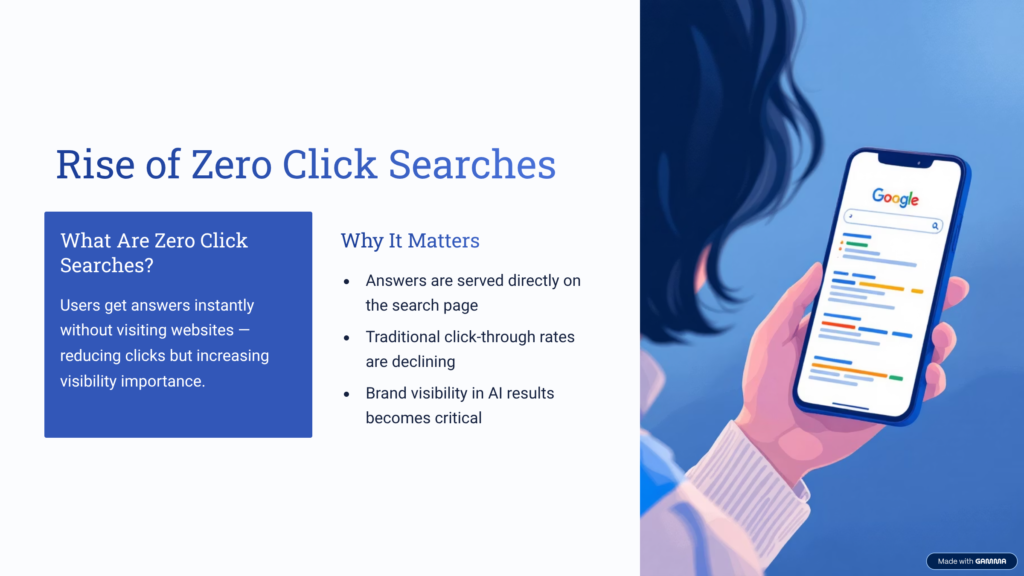
One of the most significant outcomes of AI Overview is the increase in zero-click searches. In this scenario, users receive complete answers directly on the search results page and do not feel the need to visit any website.
While this might seem like a disadvantage, it actually presents a different kind of opportunity. When a website is cited in AI Overview, it gains visibility and credibility. Even if the user does not click immediately, the brand becomes recognizable and trusted.
Over time, this recognition can influence user decisions, leading to higher conversions and direct visits. Therefore, the focus should not only be on generating clicks but also on building authority and presence within AI-generated responses.
Why Traditional SEO Alone is No Longer Enough
Limitations of Keyword-Focused Optimization
Traditional SEO strategies rely heavily on keyword optimization, backlinks, and on-page elements such as meta tags and headings. While these factors still play a role, they are no longer sufficient to achieve visibility in AI Overview.
AI systems evaluate content differently. They prioritize context, clarity, and relevance rather than just keyword density. This means that content must be written in a way that directly answers user queries and provides meaningful insights.
Simply targeting keywords without addressing user intent will not produce the desired results. The focus needs to shift from keyword placement to information quality and structure.
The Shift Toward Context and Intent
Modern search algorithms are designed to understand context and intent. This means they analyze not only what is written but also how it is written and how well it aligns with user expectations.
Content that clearly answers a specific question, provides structured information, and maintains logical flow is more likely to be selected for AI Overview. This is because such content is easier for AI systems to interpret and extract.
As a result, the strategy should focus on creating content that is informative, well-organized, and directly aligned with the user’s query.
Building a Strong Foundation for AI Overview Ranking
Focusing on a Single Primary Topic
Why Single-Topic Focus is Important
One of the most important principles for ranking in AI Overview is focusing on a single primary topic or query. When content tries to cover too many topics at once, it becomes difficult for AI systems to determine its relevance.
By concentrating on one specific topic, the content becomes more targeted and easier to understand. This increases the chances of it being selected as a reliable source for a particular query.
A focused approach also improves clarity for readers, making the content more engaging and useful.
How to Implement Topic Focus
To implement this strategy effectively, each piece of content should be centered around one main question or keyword. All sections within the content should support and expand on this primary topic.
This does not mean limiting the depth of the content. Instead, it means exploring the topic thoroughly without deviating into unrelated areas. This ensures that the content remains cohesive and relevant.
Creating Strong Title and Description Alignment
The Role of Titles in AI Overview
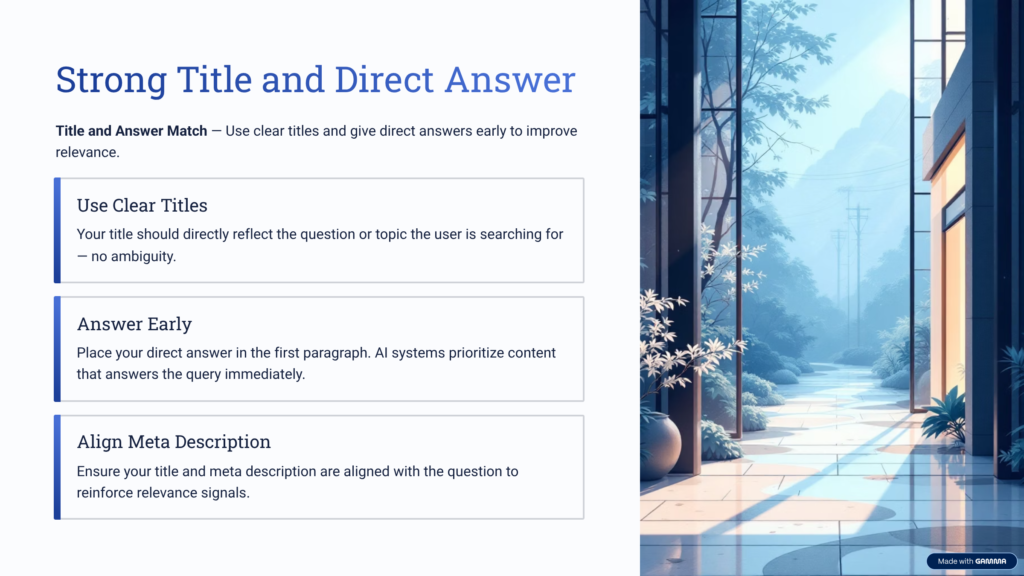
The title of a page plays a crucial role in determining its relevance. It should clearly represent the question or query that users are searching for. A well-structured title helps both users and AI systems understand what the content is about.
Titles that directly match search intent are more likely to be considered relevant. This increases the chances of the content being included in AI Overview.
Writing Descriptions as Direct Answers
Unlike traditional descriptions that provide a general overview, descriptions for AI optimization should act as direct answers. They should clearly address the query presented in the title.
This creates alignment between the title and the description, making it easier for AI systems to interpret the content. When the description directly answers the question, it signals high relevance and improves the chances of selection.
Importance of Accurate Content and Clarity
Why Accuracy Matters
Accuracy is one of the most critical factors in AI Overview ranking. Since AI systems aim to provide reliable information, they prioritize content that is factually correct and well-structured.
Inaccurate or vague content is less likely to be selected, as it does not meet the quality standards required for AI-generated responses.
Ensuring Clarity and Readability
Content should be written in a clear and simple manner. Complex sentences and unnecessary jargon can make it difficult for both users and AI systems to understand the information.
Using structured formatting, such as headings and subheadings, improves readability and helps AI systems identify key sections of the content.
Enhancing Content with Contextual Signals
Using Structured Content Formats
Importance of Structured Layout
A well-structured layout is essential for AI Overview ranking. It helps organize information in a way that is easy to scan and interpret.
Content should be divided into sections with clear headings, allowing AI systems to extract relevant information efficiently.
Providing Step-by-Step Information
Step-by-step explanations are particularly effective because they break down complex topics into manageable parts. This makes the content more useful and increases its chances of being selected as a source.
Structured explanations also improve user experience, encouraging longer engagement.
Building Authority Through Mentions and Citations
The Role of Brand Mentions
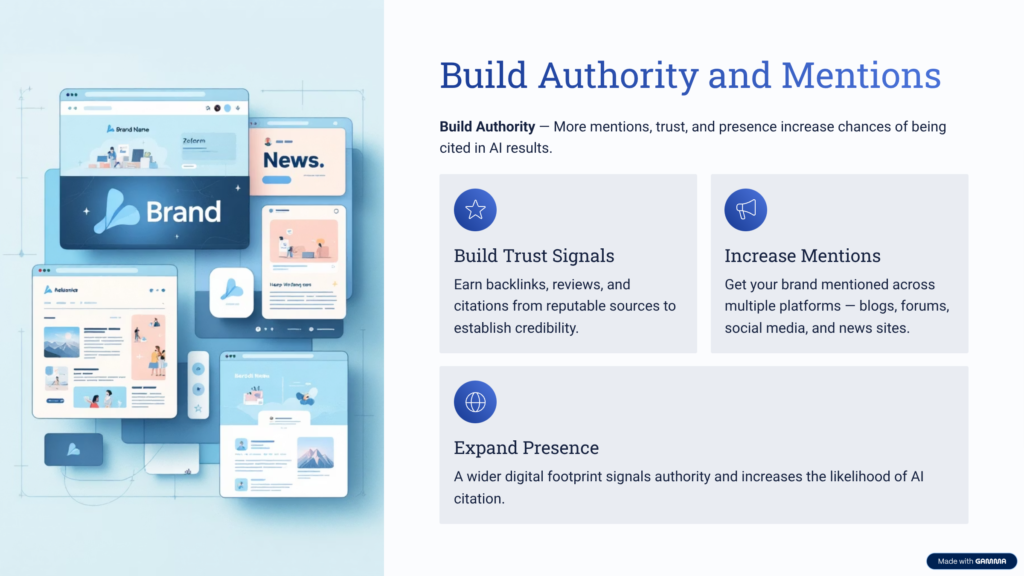
In modern SEO, brand mentions are becoming as important as backlinks. When a brand is mentioned across multiple platforms, it signals authority and relevance.
AI systems use these signals to determine which sources are trustworthy. Increasing brand mentions can significantly improve the chances of being cited in AI Overview.
Expanding Presence Across Platforms
Visibility should not be limited to a single platform. Content should be distributed across multiple channels to increase reach and recognition.
This multi-platform presence strengthens authority and improves overall visibility within AI-driven search systems.
Leveraging Data and Performance Tracking
Monitoring AI Visibility Metrics
Importance of Tracking Performance
Tracking performance is essential for understanding what works and what needs improvement. Metrics such as citations, query coverage, and visibility trends provide valuable insights.
These metrics help identify successful strategies and areas that require optimization.
Using Data to Improve Strategy
Data-driven decisions are crucial for long-term success. By analyzing performance trends, it is possible to refine content strategies and focus on high-impact areas.
Continuous monitoring ensures that the strategy remains effective in a rapidly changing environment.
Continuous Optimization for Long-Term Success
Adapting to Algorithm Changes
Search algorithms are constantly evolving, and strategies must adapt accordingly. Staying updated with changes and adjusting content accordingly is essential for maintaining visibility.
Flexibility and adaptability are key factors in long-term success.
Maintaining Content Quality
Consistently producing high-quality content is the foundation of AI Overview ranking. Quality should never be compromised, as it directly impacts credibility and visibility.
Regular updates and improvements ensure that content remains relevant and effective.
Conclusion
Ranking in Google AI Overview requires a complete shift from traditional SEO practices to a more advanced and strategic approach. It involves understanding how AI systems interpret content, focusing on user intent, and creating structured, high-quality information that directly answers queries.
By prioritizing clarity, accuracy, and relevance, and by building authority through consistent efforts, it is possible to achieve strong visibility within AI-generated responses. This not only enhances search presence but also establishes long-term credibility in an increasingly competitive digital landscape.
Success in this new era of search depends on the ability to adapt, innovate, and consistently deliver value through content.

Related Posts