
Welcome to this session. Today we are going to talk about one of the most foundational concepts in SEO: keywords. If you are new to SEO or content marketing, understanding keywords is the first step towards getting found on Google.
Keywords play a central role in search engine optimization because they help connect users with the information they are searching for. Every time someone searches on Google, they use specific words or phrases. These words guide search engines in identifying the most relevant content to display in the search results.
Without proper keyword usage, even high-quality content may not reach the right audience. Keywords help search engines understand the topic of your content and determine when it should appear in search results.
Understanding how keywords work allows website owners and marketers to create content that matches user searches and improves online visibility.
What Are Keywords?
Keywords are the words and phrases that people type into search engines when they are looking for something.
These search queries represent the needs, questions, and interests of users. When someone searches for information, products, or services, they use keywords that describe what they want to find.
SEO uses these keywords to help search engines understand what your content is all about so it can show up for relevant searches.
Search engines analyze the keywords present in your content to determine its relevance to a user’s search query. When your content matches the keywords people are searching for, it becomes more likely to appear in search results.

Keywords act as a bridge between users and content. They help search engines match user searches with the most relevant web pages.
Importance of Keywords in SEO
Keywords help connect the right audience with your content. When used strategically, they improve your chances of appearing in search results, increasing your traffic, visibility and ultimately conversions.
Proper keyword usage ensures that your content reaches users who are actively searching for related information. This targeted approach improves the effectiveness of SEO efforts.
Keywords help in:
- Improving search visibility
- Attracting relevant traffic
- Increasing website visits
- Reaching the right audience
- Improving conversions
When content includes relevant keywords, search engines can better understand its topic and purpose. This improves the chances of ranking website higher in Google search results.
Well-researched keywords allow businesses and content creators to focus on topics that users are actually searching for.
Types of Keywords in SEO
Not all keywords are the same. In SEO, we typically categorize them into different types based on length, intent, and purpose.
Different types of keywords serve different roles in SEO strategies. Understanding these categories helps in selecting the right keywords for content.
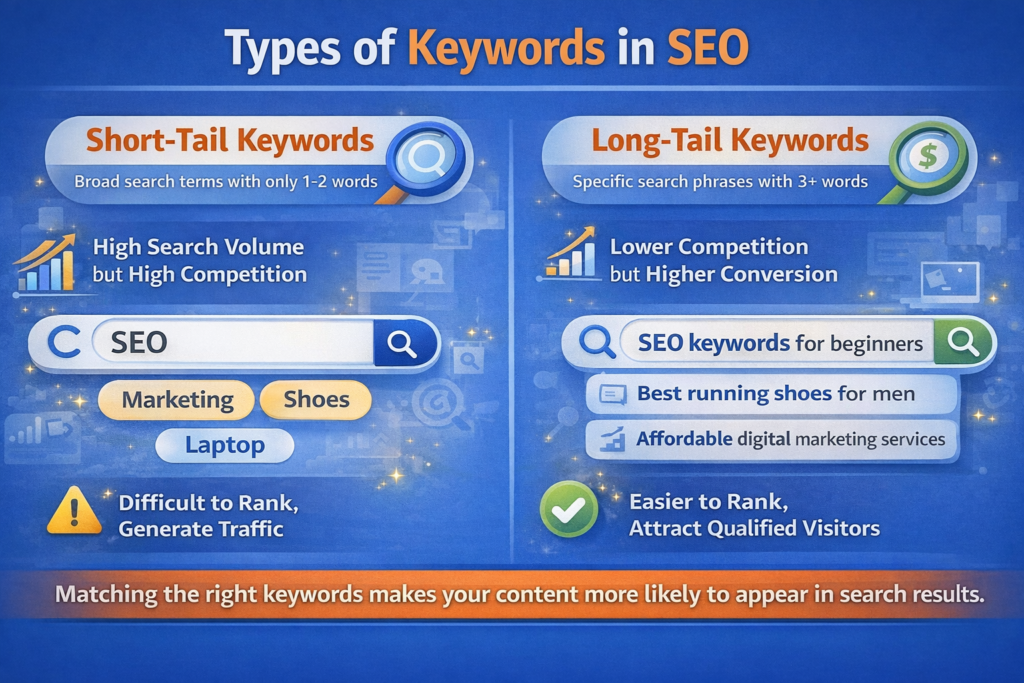
Short-Tail Keywords
Short-tail keywords are broad search terms that usually contain one or two words.
Short-tail keywords have high search volume, but also high competition.
These keywords are searched frequently by users, which makes them attractive for generating traffic. However, ranking for short-tail keywords can be difficult because many websites compete for them.
Examples include:
Short-tail keywords help bring large amounts of traffic, but they may not always bring highly targeted visitors.
Long-Tail Keywords
Long-tail keywords are more specific search phrases that usually contain three or more words.
Long-tail keywords are more specific and have lower competition and usually result in better conversion.
These keywords reflect more precise search intent. Users searching with long-tail keywords usually know exactly what they are looking for.
Examples include:
- SEO for beginners
- Best running shoes for men
- Affordable digital marketing services
Long-tail keywords often attract more qualified visitors because they match specific search needs.
Long-tail keywords are easier to rank for compared to short-tail keywords because fewer websites target them.
Keyword Placement on Web Pages
Using keywords in the right places on your web page helps both search engines and users.
These placements improve relevance and visibility. Proper keyword placement allows search engines to quickly understand the topic of a page.
Keywords should be included naturally in important areas of a web page to improve SEO performance.
Important placement areas include:
- Page titles
- Headings
- Content paragraphs
- URLs
- Meta descriptions
Correct placement improves the connection between search queries and web pages.
Natural keyword placement also improves readability and user experience.

Keyword Research
Finding the right keywords is a research process. You can use SEO tools to discover what people are actually searching for and how difficult it is to rank for those terms.
Keyword research helps identify search terms that have good search volume and manageable competition.
Proper research ensures that content is created around topics that users care about.
Keyword research helps in:
- Identifying popular search terms
- Understanding competition
- Finding content opportunities
- Planning content strategies
Keyword research is an ongoing process. Search trends change over time, and new keywords emerge regularly.
Steps to Find the Right Keywords
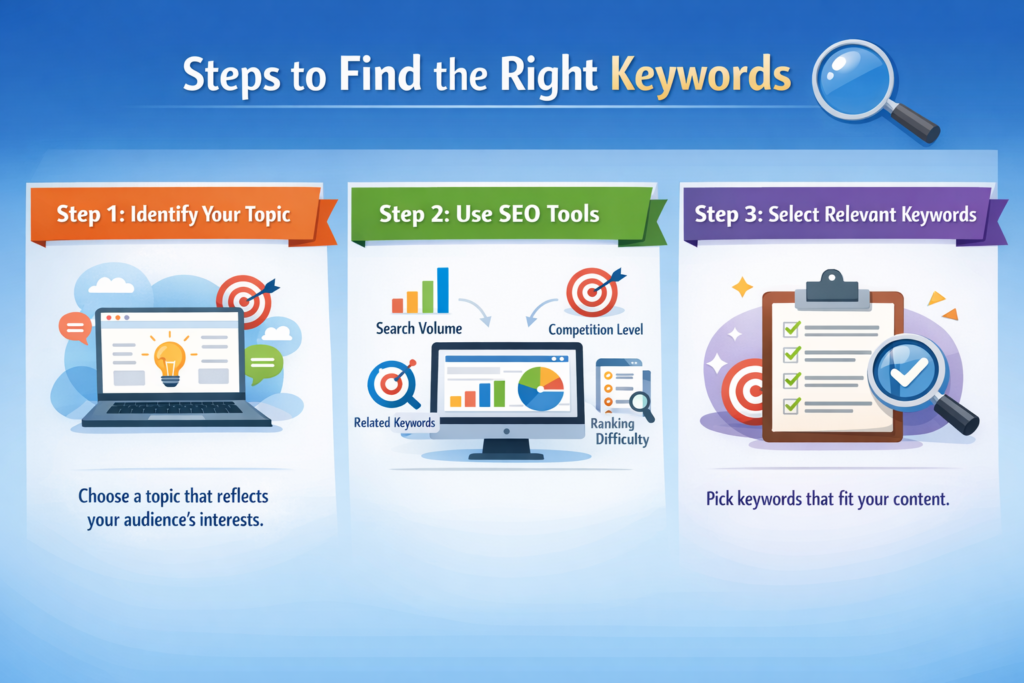
Step 1: Identify Your Topic
Start by identifying the main topic of your content.
The topic should reflect what your audience is interested in and what your website offers.
Choosing the right topic ensures that keyword research stays focused and relevant.
Step 2: Use SEO Tools
You can use SEO tools to discover keywords and analyze their difficulty.
These tools show:
- Search volume
- Competition level
- Related keywords
- Ranking difficulty
SEO tools help in selecting keywords that provide the best ranking opportunities.
Step 3: Select Relevant Keywords
Choose keywords that closely match your content.
Relevant keywords improve search engine understanding and user satisfaction.
Selecting the right keywords increases the chances of ranking in search results.
Search Intent
Every keyword has a purpose behind it. This is called search intent.
Search intent explains why a user performs a search. Understanding intent helps create the right content.
When content matches user intent, search engines are more likely to rank it higher.
Search intent can be divided into different categories.
Informational Intent
Informational intent occurs when users search for information.
Users want to learn something or find answers to questions.
Examples include:
- What is SEO
- How keywords work
- SEO tutorial for beginners
Informational content focuses on education and explanation.
Navigational Intent
Navigational intent occurs when users search for a specific website or brand.
Users already know where they want to go and use search engines to find it.
Examples include:
Navigational searches focus on reaching a specific destination.
Transactional Intent
Transactional intent occurs when users want to take an action.
This action usually involves buying a product or signing up for a service.
Examples include:
- Buy running shoes online
- Purchase SEO tools
- Order laptop online
Transactional content focuses on conversions.
Commercial Intent
Commercial intent occurs when users are researching products or services before making a decision.
Users compare options before buying.
Examples include:
- Best SEO tools
- Top digital marketing agencies
- Laptop comparison
Commercial content helps users evaluate choices.
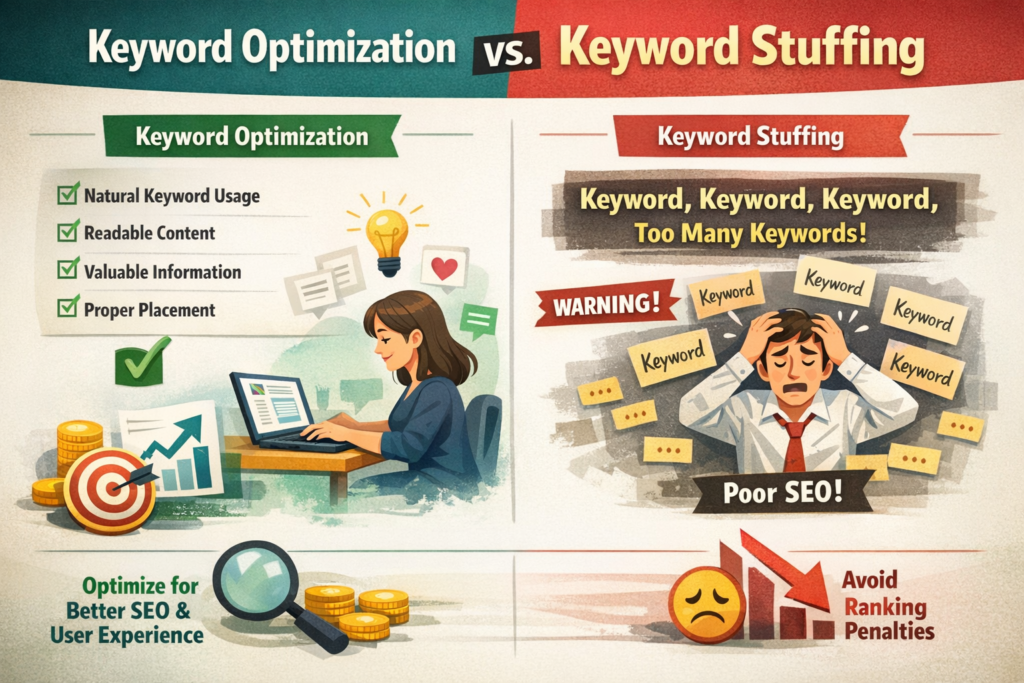
Keyword Optimization vs Keyword Stuffing
Be careful. Using too many keywords can harm your SEO. This is called keyword stuffing.
Keyword stuffing happens when keywords are repeated excessively in content in an unnatural way.
Search engines consider keyword stuffing as poor practice and may reduce rankings for such pages.
Instead, aim for keyword optimization using them naturally within valuable content.
Keyword optimization focuses on:
- Natural keyword usage
- Readable content
- Valuable information
- Proper keyword placement
Natural usage improves both SEO performance and user experience.
Well-optimized content maintains a balance between keywords and readability.
Conclusion
To summarize, keywords are the foundation of SEO. They help your content show up in search results, attract the right users, and ultimately grow your online presence.
Keywords help search engines understand your content and match it with relevant searches.
Proper keyword research and optimization improve visibility and traffic.
Understanding keyword types, placement, and search intent allows you to create effective content.
Using keywords strategically helps websites reach their target audience and improve long-term growth.

Related Posts