Welcome to this article. If you are learning SEO, you have probably heard the term keyword stuffing. But what does it really mean, and why is it bad for your website?
Keyword stuffing is one of the most common mistakes beginners make when trying to rank higher in search engines. In this guide, we will explain what keyword stuffing is, why it is harmful, how Google detects it, and what you should do instead.
What Is Keyword Stuffing?
Keyword stuffing is when a web page uses a keyword or phrase too many times unnaturally in an attempt to manipulate search engine rankings.
Instead of writing naturally, the content forces the same keyword repeatedly into sentences.
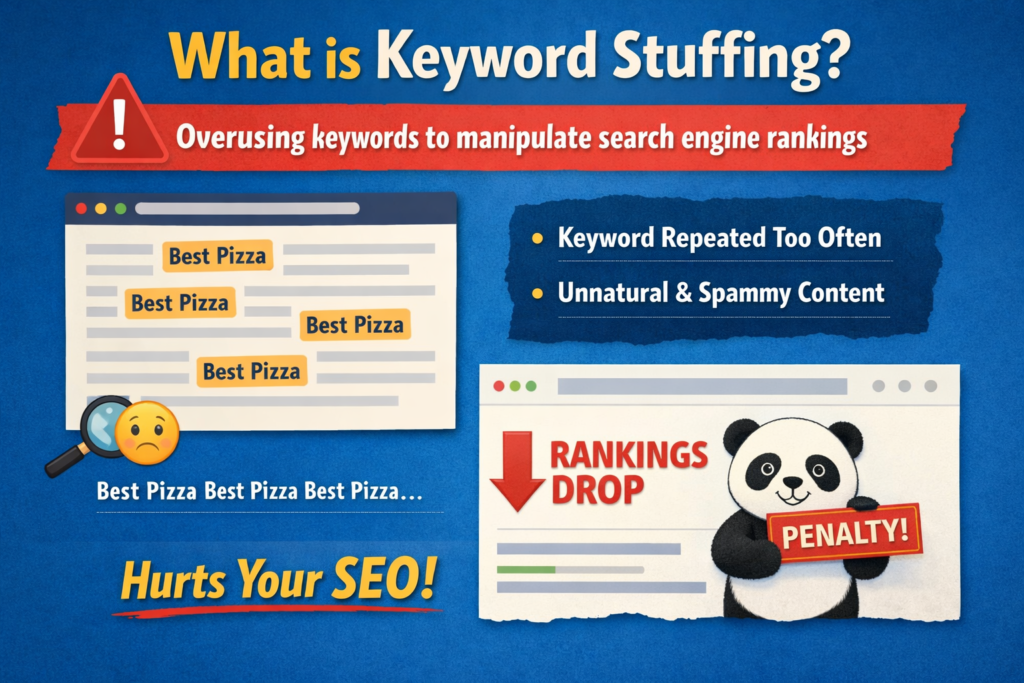
This practice may have worked in the early days of SEO, but today it is a major red flag for Google.
Example of Keyword Stuffing
Let’s say your keyword is “best digital camera.”
Now consider this sentence:
“Looking for the best digital camera? Our best digital camera is the best digital camera you will find.”
This clearly sounds unnatural and repetitive. It does not improve readability or provide value to the user.
Instead, it damages the user experience.
Why Keyword Stuffing Is Bad for SEO
Keyword stuffing not only ruins the reading experience but also goes against Google’s quality guidelines.
It can:
- Hurt your rankings
- Reduce credibility
- Trigger algorithm penalties
- Even cause deindexing in severe cases
Google prioritizes helpful and user-focused content. Over-optimization signals manipulation.
How Google Detects Keyword Stuffing
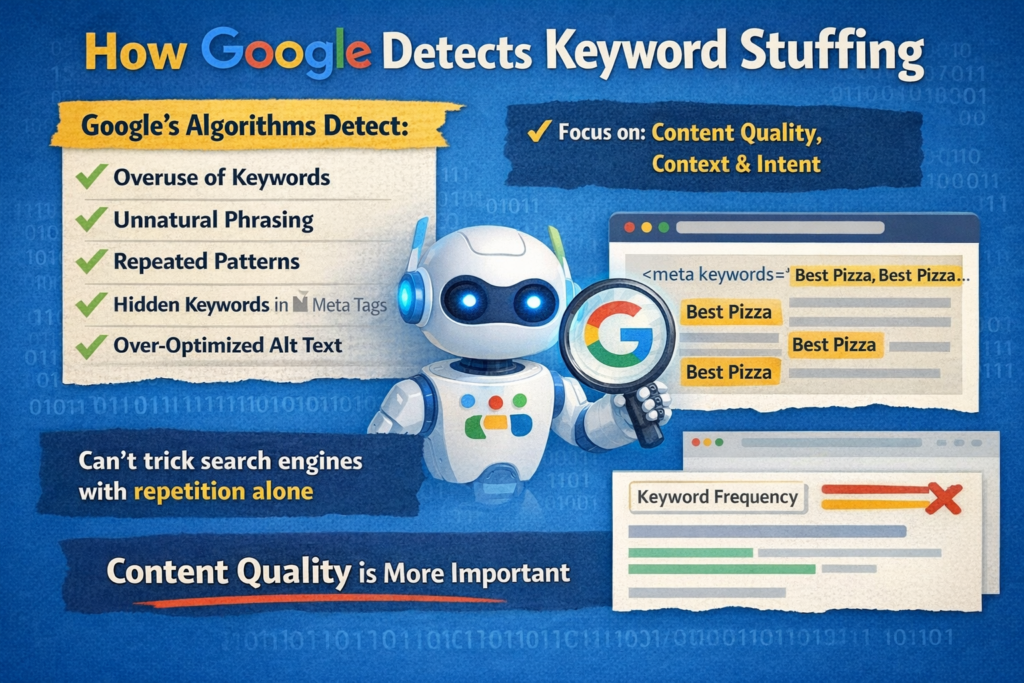
Google’s algorithms are highly advanced.
They detect:
- Overuse of keywords
- Unnatural phrasing
- Repeated patterns
- Keyword stuffing hidden in meta tags
- Over-optimized alt text
It is not possible to trick modern search engines with repetition alone.
Search engines now focus on content quality, context, and intent rather than keyword frequency.
The Impact on User Experience
Keyword stuffing makes content:
- Difficult to read
- Repetitive
- Annoying
- Less trustworthy
When users encounter poorly written content, they are more likely to leave the page quickly.
This increases bounce rate and decreases engagement, which indirectly affects SEO performance.
Proper Keyword Usage
Instead of stuffing keywords, focus on natural keyword placement.
Use:
- Synonyms
- Related terms
- Variations
- Contextual phrases
Write for your users first, not for algorithms.
Search engines are designed to reward helpful and natural content.
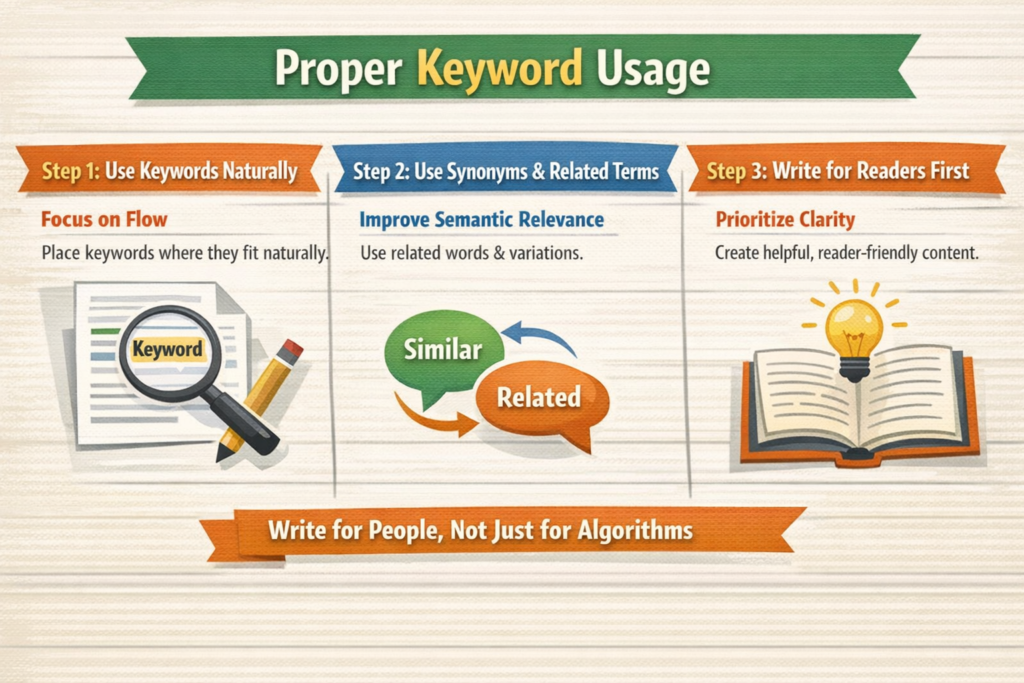
Step 1: Use Keywords Naturally
Focus on Flow
Insert keywords where they fit naturally within the sentence.
Step 2: Use Synonyms and Related Terms
Improve Semantic Relevance
Instead of repeating the same phrase, use related words and variations.
Step 3: Write for Readers First
Prioritize Clarity
Make sure your content sounds natural and informative.
Ideal Keyword Density
A good rule of thumb is to keep keyword density between 1 to 2%.
That means:
If your blog post has 100 words, use your main keyword once or twice, not 10 times.
Balanced usage signals relevance without appearing spammy.
However, keyword density should not be your primary focus. Natural writing is more important than mathematical precision.
Tools to Monitor Keyword Usage
You can use SEO tools to monitor your keyword usage and avoid over-optimization.
Some popular tools include:
- Yoast SEO
- Surfer SEO
- Rank Math
These tools alert you if:
- You are using a keyword too much
- You are using it too little
- Your placement is unnatural
Regular monitoring ensures balanced optimization.
Common Signs of Keyword Stuffing
Watch out for these warning signs:
- Repeating the same phrase in every paragraph
- Adding keywords where they do not make sense
- Stuffing keywords into meta descriptions unnaturally
- Overusing keywords in alt text
- Writing robotic and unnatural sentences
If your content sounds awkward when read aloud, it may be over-optimized.
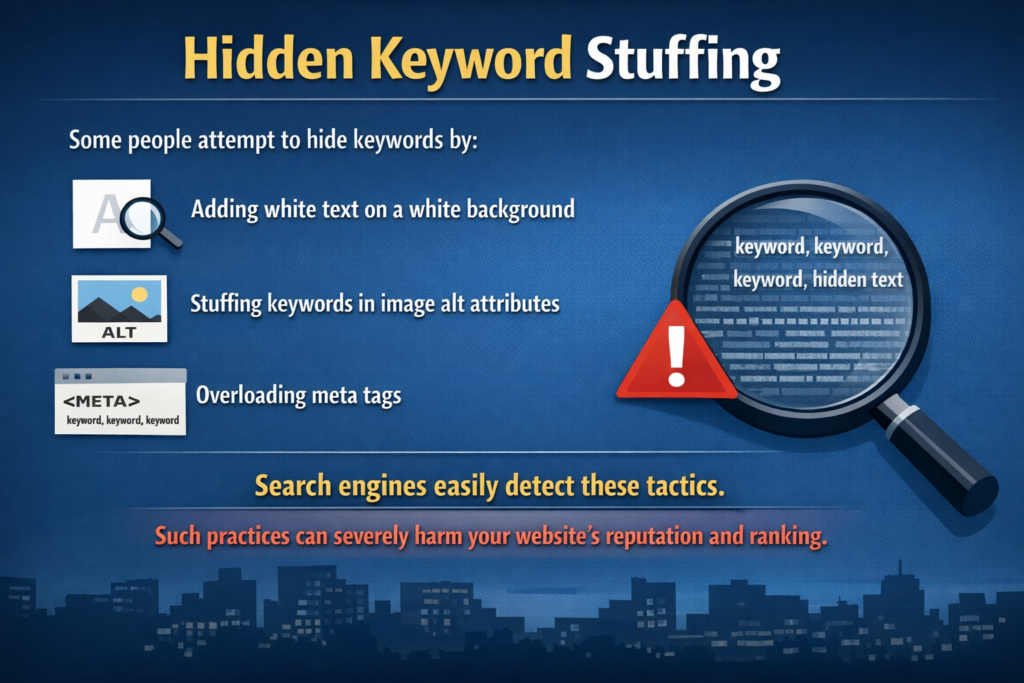
Hidden Keyword Stuffing
Some people attempt to hide keywords by:
- Adding white text on a white background
- Stuffing keywords in image alt attributes
- Overloading meta tags
Search engines easily detect these tactics.
Such practices can severely harm your website’s reputation and ranking.
Modern SEO Approach
Modern SEO focuses on:
- Search intent
- Content quality
- Topic depth
- Semantic relevance
- User engagement
Search engines analyze the entire context of your content rather than just counting keyword frequency.
High-quality content that answers user questions effectively performs better than keyword-heavy pages.
Benefits of Natural Optimization
When you avoid keyword stuffing and write naturally, you achieve:
- Better readability
- Higher engagement
- Improved trust
- Sustainable rankings
Natural optimization creates long-term SEO success.
Step-by-Step Guide to Avoid Keyword Stuffing
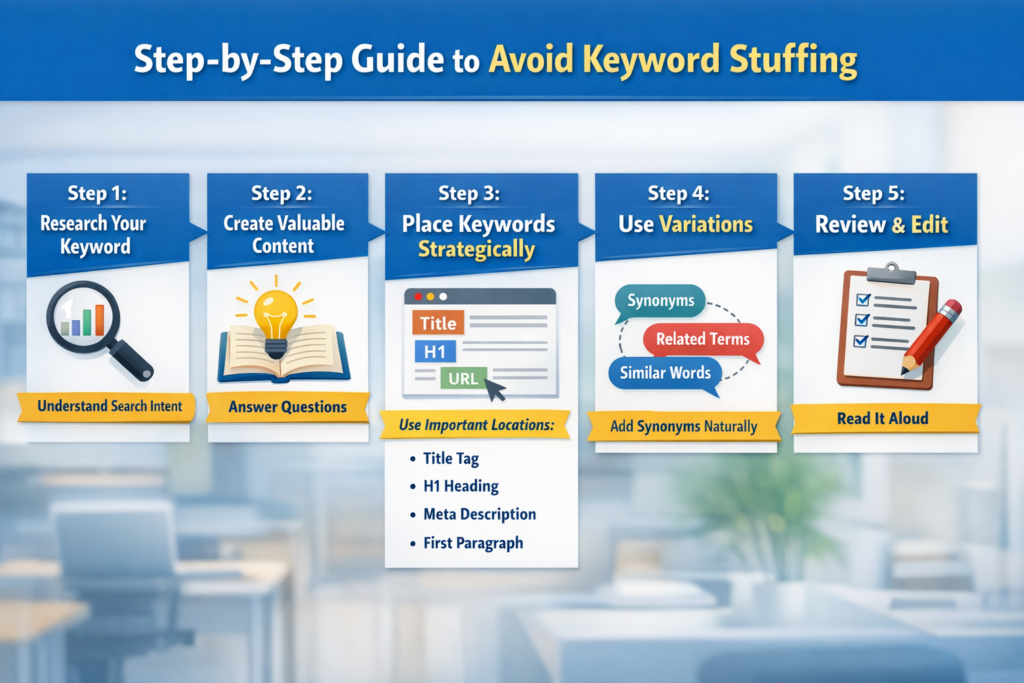
Step 1: Research Your Keyword
Understand Search Intent
Know why users are searching for the keyword.
Step 2: Create Valuable Content
Focus on Answering Questions
Provide clear and helpful information.
Step 3: Place Keywords Strategically
Use Important Locations
Include your main keyword in:
- Title tag
- Meta description
- H1 heading
- First paragraph
- URL
But avoid repetition.
Step 4: Use Variations
Strengthen Context
Add related terms and synonyms naturally.
Step 5: Review and Edit
Read It Aloud
If it sounds unnatural, revise it.
Why Keyword Stuffing Is Outdated
In short, keyword stuffing is outdated and risky.
Search engines have evolved significantly.
What once worked as a ranking tactic now harms your website’s credibility and visibility.
SEO is no longer about tricking algorithms. It is about creating meaningful and valuable content.
Final Summary: Focus on Quality, Not Repetition
To summarize, keyword stuffing is the practice of overusing keywords unnaturally to manipulate rankings.
It:
- Hurts readability
- Violates Google guidelines
- Risks penalties
- Damages user trust
Instead of stuffing keywords, focus on natural placement, relevant variations, and user-friendly writing.
Keep keyword density around 1 to 2%, but prioritize clarity over numbers.
If readers love your content, search engines will too.
Create content that is helpful, clear, and naturally optimized. That is the true path to long-term SEO success.

Related Posts