Welcome to today’s session. In this article, we will explore one of the most important but often overlooked parts of SEO: search intent. If you want to rank higher on Google and truly satisfy your visitors, understanding search intent is absolutely critical.
Many website owners focus only on keywords, backlinks, and technical optimization. While these elements are important, they are not enough. If your content does not match what the user actually wants, it will struggle to rank. Search engines now prioritize relevance and user satisfaction more than ever before.
What is Search Intent?
Search intent, also called user intent, refers to the reason behind a user’s search query. In simple terms, it answers the question: why did the person type this into Google?
When someone searches online, they always have a purpose. They may want to:
- Learn something
- Buy a product
- Compare options
- Find a specific website
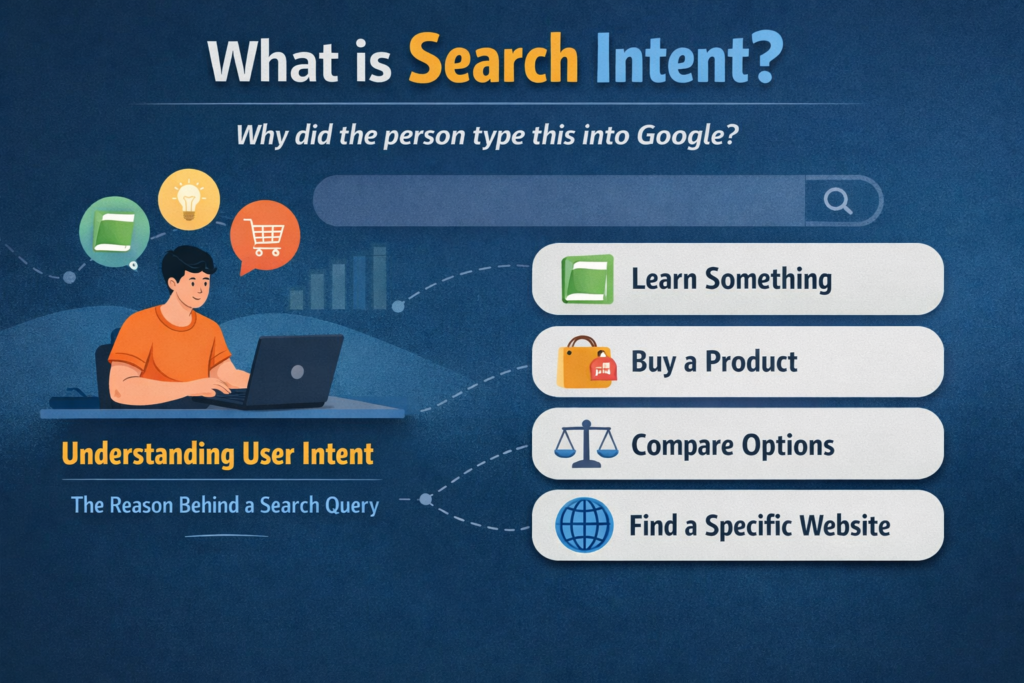
Understanding this purpose is the key to creating content that ranks well and delivers value.
Why Search Intent Is Important for SEO
Search engines like Google focus heavily on user intent to deliver the best results. Their goal is to provide the most relevant answer to a search query.
If your content does not match the user’s purpose, it will not rank, even if it is perfectly optimized otherwise. You may use the right keywords and follow technical SEO best practices, but if the format and message do not align with intent, Google will favor other pages.
Search intent helps you:
- Create relevant content
- Improve user satisfaction
- Reduce bounce rate
- Increase conversions
- Achieve better rankings
Matching intent is no longer optional. It is essential.
The Four Main Types of Search Intent
Search intent can be broken into four main types. These categories help us understand what kind of content to create for each keyword.
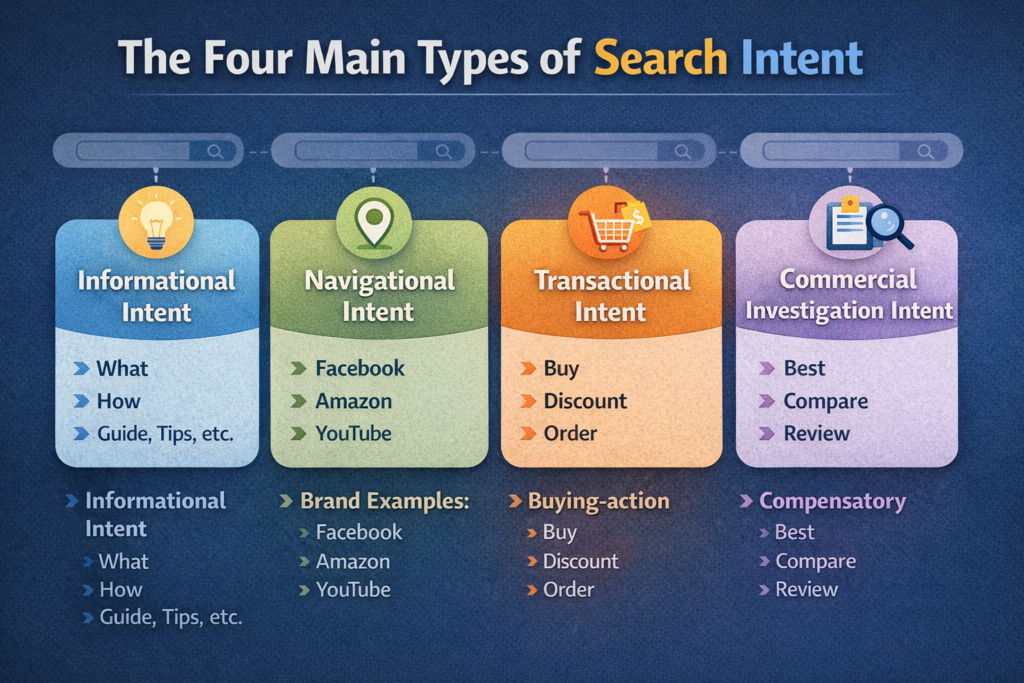
Informational Intent
What Is Informational Intent?
Informational intent means the user is simply looking for knowledge. They are asking questions such as:
- What
- Why
- How
- When
These searches are focused on learning.
Best Content for Informational Intent
Content formats that work best include:
- Blog posts
- Guides
- Tutorials
- Videos
- Educational articles
For example, if someone searches “how to improve SEO,” they are looking for information, not a sales page.
Your goal is to provide clear, detailed, and helpful explanations.
Navigational Intent
What Is Navigational Intent?
With navigational intent, users already know where they want to go. They type branded or specific website names into the search engine.
For example:
- Facebook login
- Amazon official site
- YouTube homepage
The user’s goal is to reach a specific website or page.
How to Optimize for Navigational Intent
Your goal is to make sure your site appears prominently when users search for your brand or product name.
To achieve this:
- Optimize branded keywords
- Ensure accurate meta titles and descriptions
- Maintain strong brand visibility
If someone searches for your company name, your website should be the top result.
Transactional Intent
What Is Transactional Intent?
Transactional intent means the user is ready to make a purchase or complete an action.
These searches often include words like:
- Buy
- Order
- Discount
- Price
- Book
These are your money keywords.
Best Content for Transactional Intent
Your content should guide the user toward conversion. Effective formats include:
- Product pages
- Landing pages
- Service pages
- Checkout pages
The goal is to make it easy for users to take action.
Commercial Investigation Intent
What Is Commercial Investigation Intent?
This is where users are considering their options before buying. They are comparing features, reading reviews, or asking which is the best product.
For example:
- Best laptop for students
- iPhone vs Samsung comparison
- Top digital marketing courses
The user is close to making a decision but wants more information first.
Best Content for Commercial Investigation Intent
To help users decide, create:
- Comparison articles
- Review posts
- “Best of” lists
- Feature breakdowns
Provide honest and useful content. Help them evaluate options clearly.
How to Identify Search Intent
Identifying search intent is a crucial step before creating content.
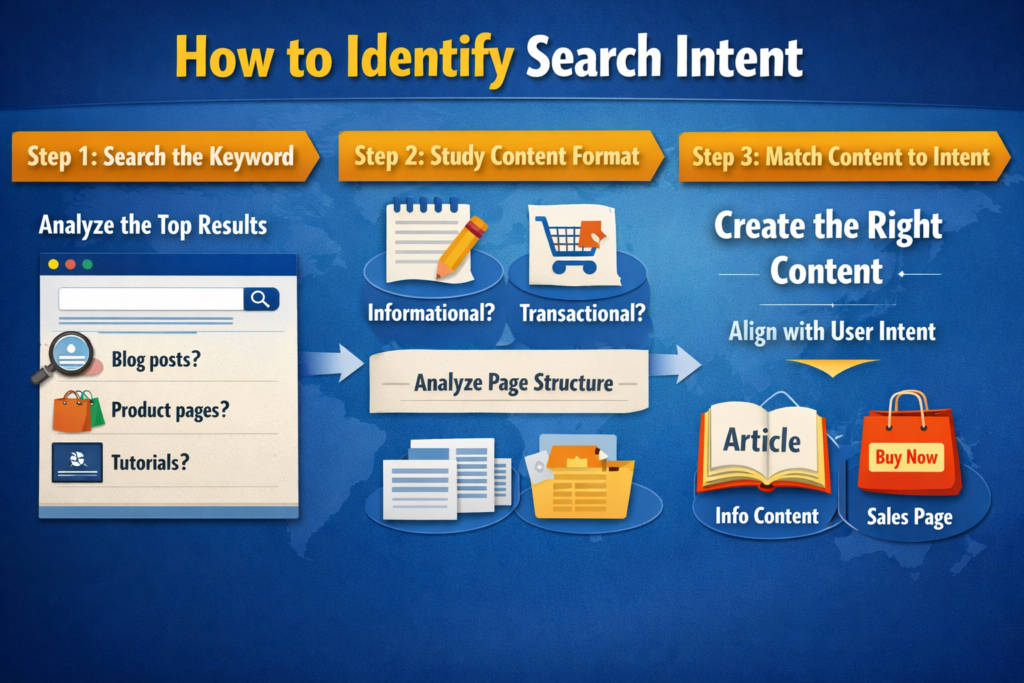
Step 1: Search the Keyword Yourself
Analyze the Top Results
Start by Googling the keyword yourself. Look at the top-ranking results.
Ask yourself:
- Are they blog posts?
- Are they product pages?
- Are they tutorials?
The format of the top results tells you what Google believes the user wants.
Step 2: Study Content Format
Observe Page Structure
If most top results are blog posts, the intent is likely informational.
If they are product pages, the intent is likely transactional.
Google’s ranking pattern is a strong indicator of intent.
Step 3: Match Content to Intent
Tailor Your Content Accordingly
Once you understand the intent, create content that aligns with it.
If the intent is informational, do not create a sales page.
If the intent is transactional, do not offer a lengthy educational article.
Give users exactly what they are expecting.
Common Mistakes to Avoid
Many websites fail to rank because they ignore search intent. Here are common mistakes to avoid.
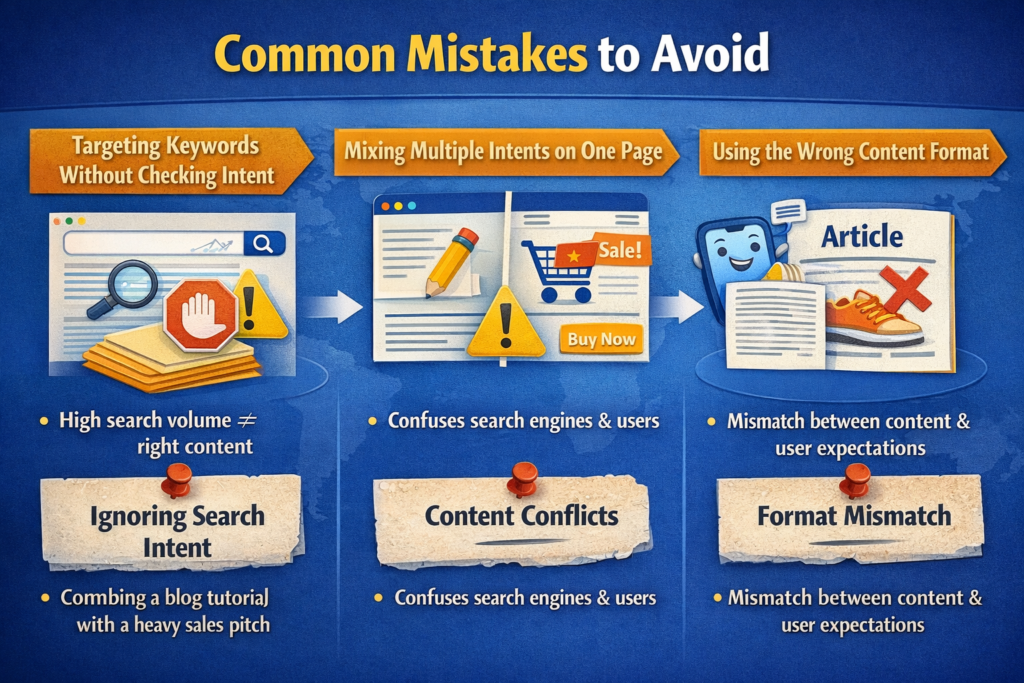
Targeting Keywords Without Checking Intent
Choosing keywords without analyzing intent can lead to poor performance.
Even if a keyword has high search volume, it may not align with your content goals.
Mixing Multiple Intents on One Page
Avoid mixing different intents on a single page.
For example:
- Combining a blog tutorial with a heavy sales pitch
- Mixing informational content with aggressive product promotion
This can confuse both users and search engines.
Using the Wrong Content Format
If users expect a comparison article and you provide a simple product description, your content may not rank.
Always match the format to user expectations.
Aligning Content with User Mindset
Always research and plan your content to match the user’s mindset.
Ask yourself:
- What stage is the user in?
- Are they learning, comparing, or ready to buy?
- What format would satisfy them most?
When your content directly addresses the user’s need, engagement improves naturally.
Why Matching Intent Improves Rankings
Google measures user satisfaction through signals such as:
- Click-through rate
- Time spent on page
- Bounce rate
- Engagement
If users quickly leave your page, it indicates that your content did not satisfy their intent.
Matching intent increases the likelihood that users will stay, read, and interact with your content.
The Relationship Between Keywords and Search Intent
It is not enough to choose the right keyword. You also need the right type of content.
A keyword alone does not guarantee ranking success. The context, format, and purpose of the content matter just as much.
For example:
- “How to lose weight” requires a detailed guide.
- “Buy protein powder online” requires a product-focused page.
Understanding the difference is critical.
Building an Intent-Based SEO Strategy
To build a strong SEO strategy:
- Research keywords.
- Identify the search intent.
- Analyze top-ranking pages.
- Create content that matches user expectations.
- Avoid mixing formats unnecessarily.
This structured approach increases your chances of ranking effectively.
Final Summary: The Power of Search Intent
To sum it up, search intent is the reason behind every query. It defines why a user performs a search.
It is not enough to choose the right keyword. You also need the right type of content to satisfy the user and rank in search engines.
When you understand and apply search intent correctly, you:
- Improve content relevance
- Increase user satisfaction
- Strengthen SEO performance
- Achieve higher rankings
Search intent connects keywords with real human needs. When your content matches those needs, your website grows effectively and sustainably.

Related Posts