Whenever we open a website, we type something in the browser’s URL bar and press Enter. Within seconds, the website appears in front of us. But have you ever wondered what that typed address is called?
That address is known as a domain name.
In this article, we will clearly understand:
- What a domain name is
- What an IP address is
- What a Domain Name Server (DNS) does
- Parts of a domain name
- Types of top-level domains
- Domain registration and renewal
Let us begin with the basics.
What Is a Domain Name?
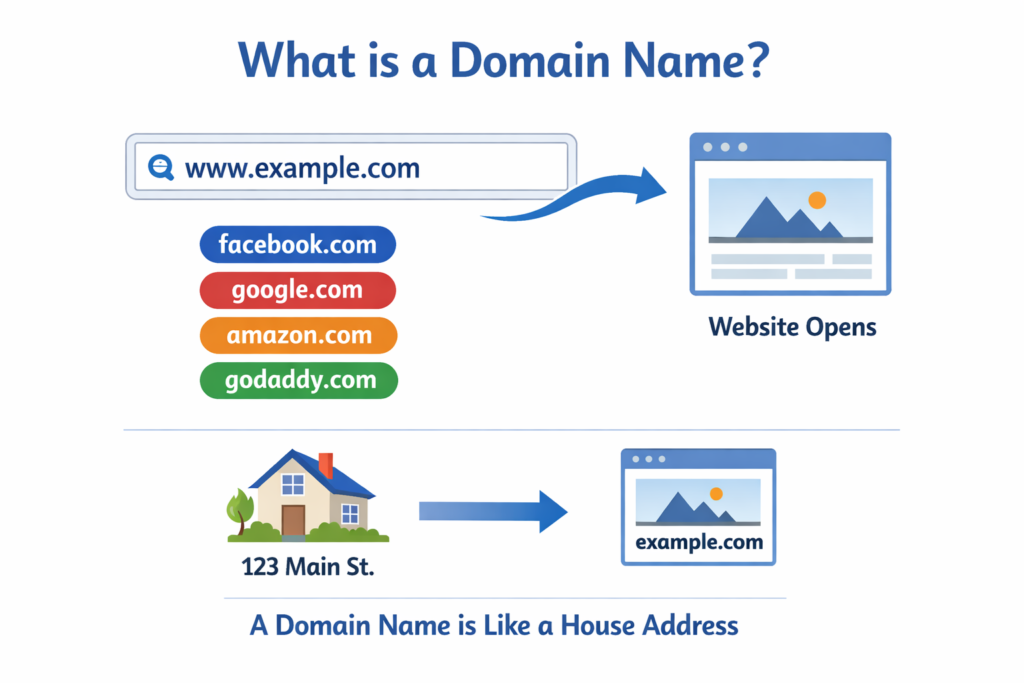
A domain name is basically the unique address of a website.
Whenever a user wants to open a website, they need to enter the domain name in the browser’s URL bar and press Enter. After that, the website appears in front of them.
For example:
- godaddy.com
- facebook.com
- google.com
- amazon.com
Each of these is a domain name.
Just like every house has a unique address, every website has a unique domain name.
How Domain Names Work
When you type:
facebook.com
and press Enter, Facebook opens.
When you type:
google.com
and press Enter, Google opens.
The domain name acts as the address that tells the browser which website to display.

What Is an IP Address?
Before domain names were introduced, websites were opened using IP addresses.
An IP address is a numerical address assigned to every website. For example:
142.250.183.14
Each website has its own IP address.
If you type a website’s IP address in the browser and press Enter, the website will open.
For example, typing Google’s IP address opens google.com.

Why Domain Names Replaced IP Addresses
In the past, users had to remember IP addresses to open websites.
But remembering numbers like:
142.250.183.14
is difficult.
Imagine if you regularly visit 5–7 websites. Remembering all their IP addresses would be almost impossible.
To solve this problem, IP addresses were replaced by domain names.
Now, instead of remembering complex numbers, you simply type:
amazon.com
and the website opens.
Domain names are easier to remember than IP addresses.

What Is a Domain Name Server (DNS)?
Now the question is:
If websites actually run on IP addresses, how does typing a domain name open the correct website?
The answer is Domain Name Server (DNS).
DNS as a Mediator
A Domain Name Server acts as a mediator between:
- Domain name
- IP address
When you type amazon.com:
- The browser sends a request.
- DNS checks its records.
- DNS matches amazon.com with its IP address.
- The correct IP address is opened.
So DNS connects the domain name to the IP address automatically.
DNS Explained with a Simple Example
Think of your phone contacts.
If you want to call someone:
- You do not type their mobile number every time.
- You save their name in your contacts.
- You search their name and press Call.
Similarly:
- The IP address is like the phone number.
- The domain name is like the contact name.
- DNS is like your contact list.
It stores the mapping between names and numbers.
When you type a domain name, DNS finds the correct IP address and opens the website.
Parts of a Domain Name
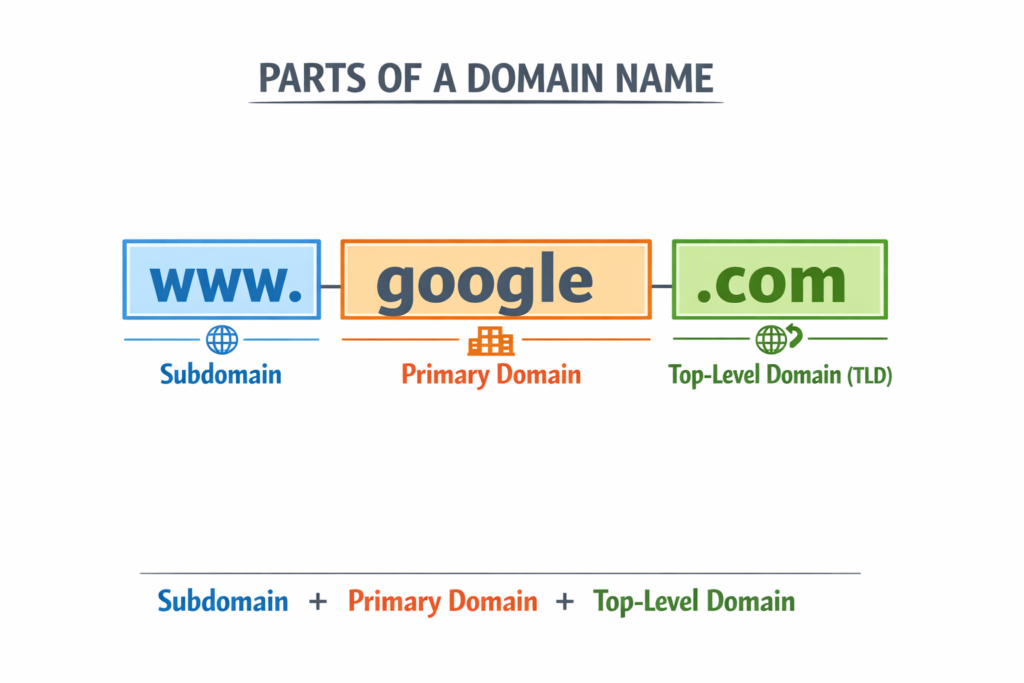
A domain name is divided into three main parts.
Let us take this example:
1. Subdomain
www
This is called a subdomain.
2. Primary Domain
This is the primary domain name.
3. Top-Level Domain (TLD)
.com
This is called the top-level domain.
So domain names are structured as:
Subdomain + Primary Domain + Top-Level Domain
What Is a Top-Level Domain (TLD)?
The top-level domain is the extension at the end of a domain name.
Examples:
- .com
- .in
- .us
- .uk
- .edu
- .gov
- .ai
There are many types of top-level domains.
Types of Top-Level Domains
1. .com
Represents commercial websites.
Most people have a habit of opening .com websites.
It is the most popular and preferred domain extension.
2. Country-Based TLDs
Some TLDs represent countries:
- .in → India
- .us → United States
- .uk → United Kingdom
- .pk → Pakistan
These are called country code top-level domains (ccTLDs).
3. Special Purpose TLDs
Some domains are for specific purposes:
- .edu → Educational websites
- .gov → Government websites
- .ai → Artificial Intelligence related websites
There are many such domain extensions available.
Domain Availability
When purchasing a domain, it must be unique.
If someone has already purchased a domain name:
- No one else can buy the same domain name.
For example:
If someone owns example.com,
you cannot buy example.com again.
Domain names are unique.

Domain Purchase and Renewal
When you purchase a domain:
- You do not buy it permanently.
- You buy it for a fixed period.
For example:
- 1 year
- 3 years
- 5 years
After that period, you must renew the domain.
If you do not renew it:
- The domain may expire.
- Someone else may purchase it.
So you must pay renewal fees regularly to keep ownership.
Choosing the Right Domain Extension
When buying a domain, many extensions are available.
For example:
- example.com
- example.in
- example.store
- example.club
Although many options exist, people generally prefer .com domains.
If you are planning to purchase a domain, it is recommended to give priority to the .com extension because:
- It is widely recognized.
- It builds credibility.
- Users trust .com websites more.
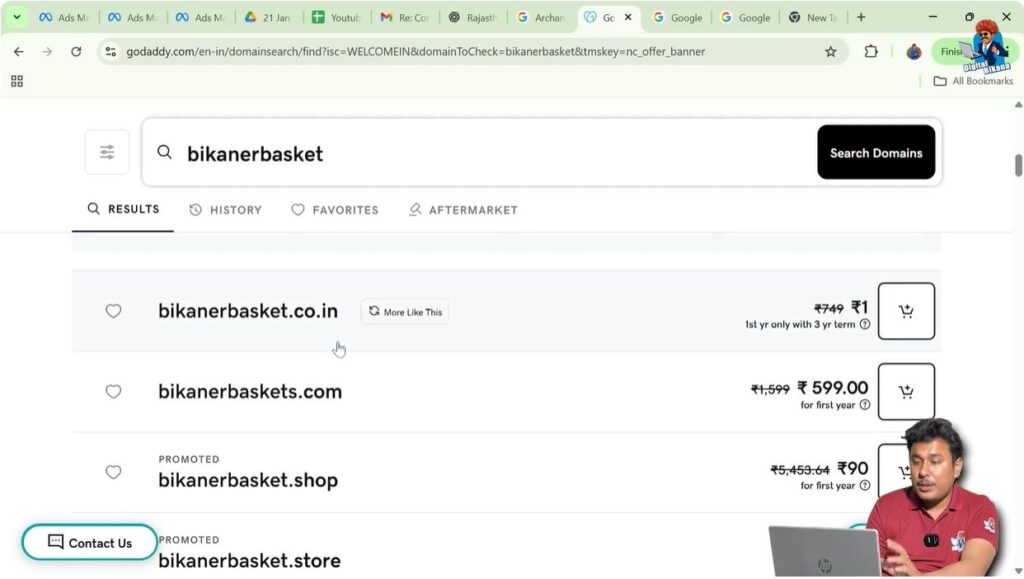
Example of Domain Search
When you search for a domain on platforms like GoDaddy:
- It shows whether the domain is available.
- If available, you can purchase it.
- If already taken, you must choose another name or extension.
Why Domain Names Are Important
Domain names are important because:
- They make websites easy to access.
- They replace complex IP addresses.
- They build brand identity.
- They are easier to remember.
Without domain names, internet usage would be complicated.
Simple Definition of Domain Name
In simple words:
A domain name is the address of a website.
Just like a house has an address, a website has a domain name.
Final Summary
Let us summarize everything:
- Domain name is the unique address of a website.
- IP address is the numerical address of a website.
- DNS connects domain names to IP addresses.
- Domain names replaced IP addresses because they are easier to remember.
- Domain names have three parts: subdomain, primary domain, and top-level domain.
- .com is the most popular TLD.
- Domains must be renewed after a fixed period.
- Domain names are unique and cannot be duplicated.
Conclusion
A domain name is the unique and human-readable address of a website that allows users to access websites easily without remembering complex numerical IP addresses. It works together with the Domain Name Server, which connects the typed domain name to the correct IP address.
Domain names are structured into subdomain, primary domain, and top-level domain. Among various extensions available, .com remains the most widely used and preferred option.
Understanding domain names is essential for anyone planning to create a website or establish an online presence.

Related Posts