In this article we are going to discuss what a lookalike audience is in Facebook ads in detail. Audience targeting plays a very important role in Facebook advertising. After running ads and getting engagement, advertisers often want to reach more people who are similar to those who already showed interest in their ads. This is where the concept of lookalike audience comes into use. This article explains what a lookalike audience is, where it is created inside Ads Manager, how it is formed, and why advertisers use it to improve results in future ad campaigns.
Where Lookalike Audience is Created in Ads Manager?
Step 1: Open Meta Ads Manager
To understand lookalike audiences, the first step is to enter Meta Ads Manager.
Once you are inside Ads Manager, you can access all advertising tools provided by Meta.

Step 2: Go to the Audiences Section
Inside Ads Manager, look at the left-side toolbar.
There is an option called Audiences. When you click on this option, you are taken to the Audiences page where all audience-related settings are available.
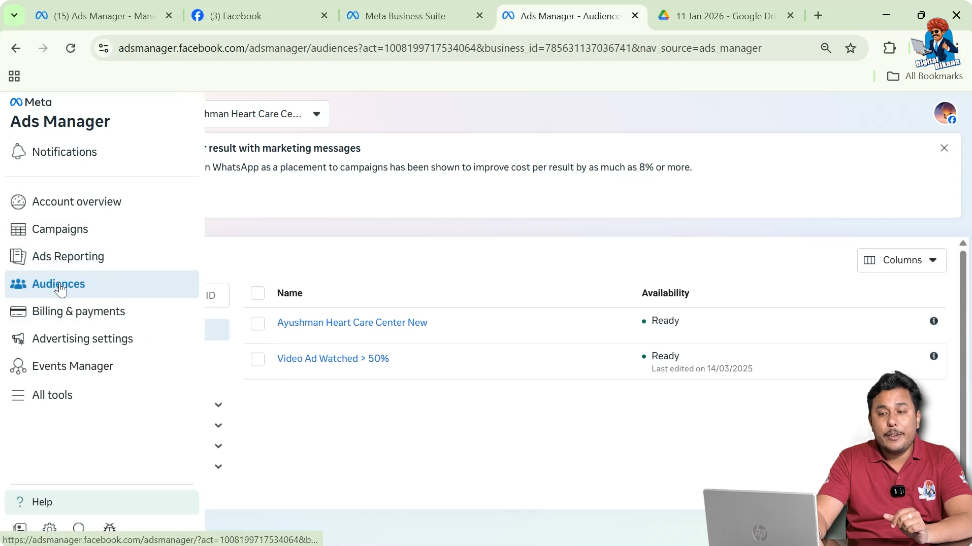
Step 3: Click on Create Audience
On the Audiences page, there is a button called Create Audience.
When you click on this button, Meta gives you different options for creating audiences.
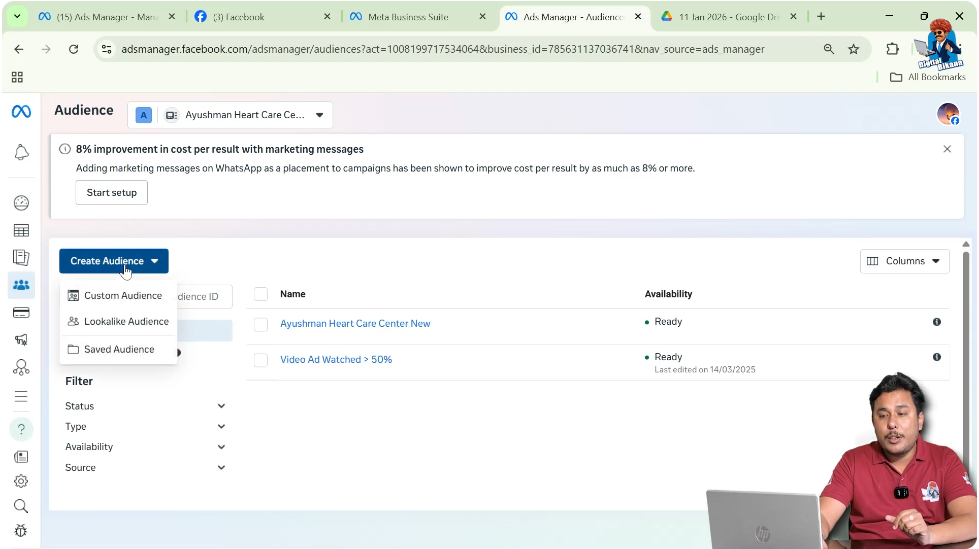
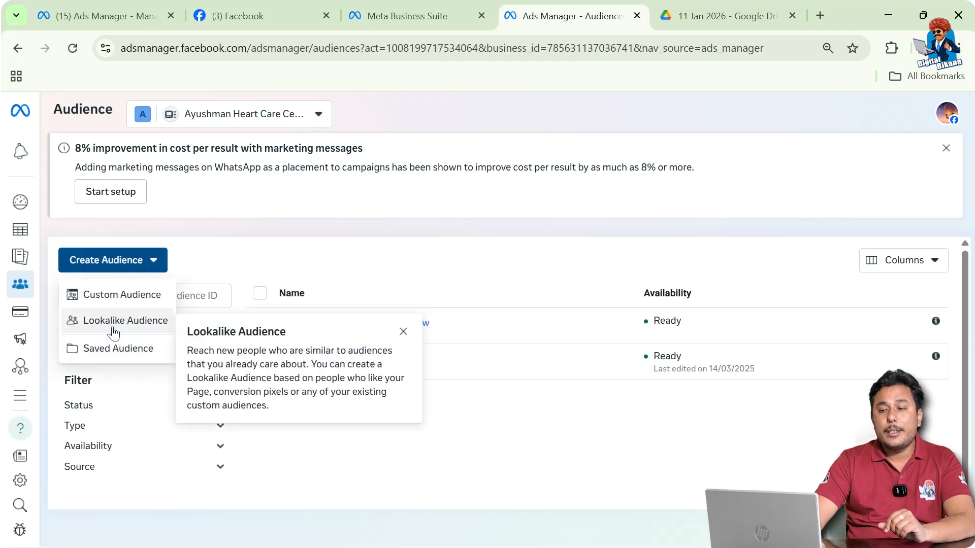
Step 4: Select Lookalike Audience
Among the available options, one of the options is Lookalike Audience.
When you select Lookalike Audience, Meta allows you to create a new audience based on existing data.
What is a Lookalike Audience?
A lookalike audience is an audience of similar people created by Meta. It is created using the data of users who have already interacted with your previous ad campaigns.
In simple words, a lookalike audience means targeting people who are similar to your existing engaged audience.
Understanding the Background of Lookalike Audience
To understand lookalike audiences properly, we need to understand what happens before creating them.
Running an Initial Ad Campaign
Before creating a lookalike audience, an advertiser must have already run at least one ad campaign.
Campaign Objective Does Not Matter
The objective of the campaign does not matter.
The ad campaign could be:
- Awareness
- Traffic
- Engagement
- Any other objective
What matters is that the ad was shown to users.
Type of Audience Used Initially
The initial ad campaign could have been run on:
- Saved audience
The advertiser may have used different detailed targeting filters.
Targeting Used in the First Campaign
While running the first ad campaign, advertisers may use:
Interest-Based Targeting
Targeting users based on their interests.
Demographic-Based Targeting
Targeting users based on demographics such as age, gender, or education.
Detailed Targeting Filters
Using multiple filters together to reach a specific group of people.
Location and Proximity Targeting
Showing ads to users living nearby or within a specific area or proximity.
Showing Ads to a Large Audience
Suppose the advertiser showed the ad to one lakh users.
These users belong to the selected audience and location.
User Interaction With Ad Creative
Out of these one lakh users, some users interact with the ad creative.
For example, around 5,000 users may interact with the ad.
Types of Interactions Considered
Users may interact with the ad creative in many ways, such as:
Watching the Ad
Users may watch the ad content.
Clicking the CTA Button
Users may click on the call-to-action button.
Engaging With the Ad
Users may:
- Like the ad
- Share the ad
- Comment on the ad
Visiting Social Profiles
Users may:
- Visit the Facebook profile
- Visit the Instagram profile
Meaning of Ad Interaction
Whatever action the user performs, it is considered an interaction with the ad creative.
These interactions show that the user has shown interest in the ad.
Importance of These Interactions
These interactions are very important because they help Meta understand which type of users are interested in the ad.
Why Advertisers Create Lookalike Audiences
After getting engagement from the first campaign, advertisers want to improve results in the next campaign.
They want to reach more people who are similar to those who already interacted with the ad.
This is where lookalike audience comes into use.
Meaning of Creating a Lookalike Audience
Creating a lookalike audience means creating an audience of people who are similar in nature to your previous engaged users.
These people have:
- Similar personality traits
- Similar behavior patterns
Similar Personality Traits Explained
Similar personality traits means that:
- They behave like your engaged users
- They show interest in similar content
- They interact in similar ways on the platform
Meta identifies such users automatically.
Role of Meta in Lookalike Audience Creation
Meta analyzes the users who interacted with your previous ad.
Based on this analysis, Meta finds other users who behave in a similar manner.
These new users form the lookalike audience.
Lookalike Audience and Location
Lookalike audiences are created in the area where you are running your ads.
This ensures that:
- The audience is relevant
- The users are from the same region
- The results remain consistent
Purpose of Using Lookalike Audience
The main purpose of using a lookalike audience is to get better results in the next ad campaign.
Since the audience is similar to users who already showed interest, the chances of engagement increase.
Lookalike Audience and Improved Results
When advertisers use a lookalike audience:
- They target users similar to engaged users
- They improve audience quality
- They reduce random targeting
This leads to improved results.
Difference Between Saved Audience and Lookalike Audience
A Saved audience is selected using interests, demographics, or location.
A lookalike audience is selected based on real user interaction data.
This makes lookalike audiences more refined.
Why Lookalike Audience Is Powerful
Lookalike audience works because:
- It is based on actual engagement
- It targets similar users automatically
- It builds on previous campaign performance
Using Lookalike Audience for Next Campaign
After creating a lookalike audience, advertisers can use it in their next ad campaign.
They can target this audience directly while setting up the campaign.
Expected Outcome of Using Lookalike Audience
By using lookalike audiences, advertisers aim to:
- Get better engagement
- Reach similar people
- Improve campaign performance
Final Understanding of Lookalike Audience
A lookalike audience is an audience created by Meta using data from users who interacted with your previous ad creative.
It helps advertisers target people with similar personality traits and behavior patterns in the same area.
Final Conclusion
Lookalike audience in Facebook ads allows advertisers to create a new audience of similar people based on previous ad interactions.
After running an ad campaign and receiving engagement, advertisers can use lookalike audiences to reach users who behave like their existing engaged audience.
This helps in improving results in future ad campaigns and makes targeting more effective.

Related Posts