
Welcome. In this article, we will dive into one of the most powerful but often overlooked elements of SEO: schema markup.
This structured data helps search engines better understand your content and enhances how your website appears in search results. While many website owners focus only on keywords and backlinks, schema markup plays a crucial role in improving how your content is displayed in search engine results pages.
Let us explore what schema markup is, how it works, why it matters, and how you can implement it correctly.
What Is Schema Markup?
Schema markup is a type of structured data that you add to your HTML code.
It tells search engines exactly what your content means, not just what it says.
Search engines can read text, but they do not always fully understand the context. Schema markup provides additional information that clarifies the meaning behind your content.
For example, if your page contains a number like “4.8,” search engines may not know whether it represents a rating, a price, or a statistic. Schema markup helps specify that it is a rating.
How Schema Markup Works
Schema markup uses a standardized vocabulary from Schema.org, which Google, Bing, and Yahoo all understand.
When you add schema correctly, search engines can interpret your content more accurately.
This allows your website to appear as enhanced search results, also known as rich results.
These rich results may include:
- Star ratings
- Images
- FAQs
- Cooking time
- Product prices
- Event dates
Schema markup transforms ordinary listings into visually appealing search results.

Why Schema Markup Is Important for SEO
Adding schema does not directly affect rankings.
However, it significantly increases click-through rates, boosts search visibility, and improves how your site appears in search engine results pages.
When your listing looks more attractive and informative than others, users are more likely to click on it.
Higher click-through rates can indirectly support SEO performance by increasing engagement and traffic.
Schema markup enhances:
- Visibility
- Trust
- User experience
- Click-through rate
That makes it a powerful addition to your SEO strategy.
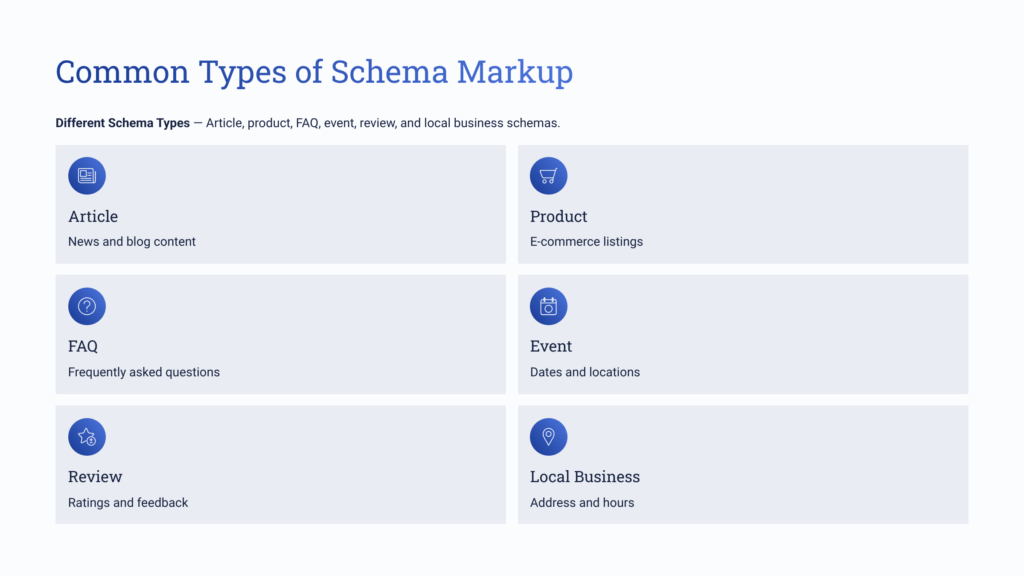
Common Types of Schema Markup
There are many types of schema markup available.
Choosing the correct type depends on your content.
Some common types include:
- Article schema
- Recipe schema
- Product schema
- FAQ schema
- Event schema
- Local business schema
- Review schema
Each type is designed to provide structured information specific to that content category.
Example of Schema Markup in Action
Let us look at a practical example.
Imagine a cooking blog that uses recipe schema.
When the page appears in search results, users can see:
- Cooking time
- Star ratings
- An image
All of this appears without the user needing to click on the page.
This enhanced listing attracts more attention compared to a plain text result.
That is the power of structured data.
Formats of Schema Markup
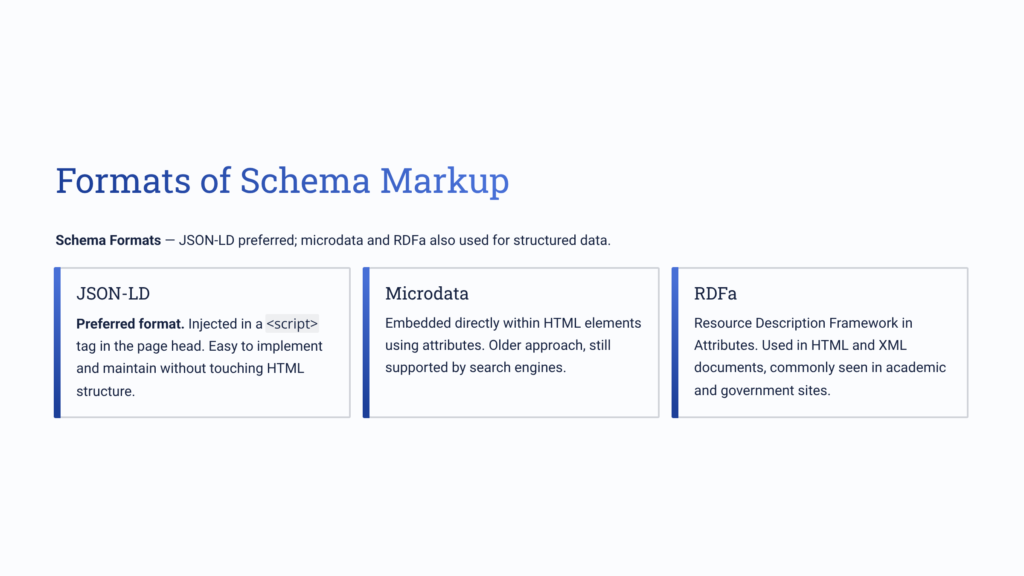
You can add schema using three main formats:
- JSON-LD
- Microdata
- RDFa
Each format works slightly differently.
JSON-LD
JSON-LD is Google’s preferred format.
It is added within a script tag in the HTML and does not interfere with visible content.
This format is clean, easy to implement, and recommended for most websites.
Microdata
Microdata is embedded directly within the HTML content.
It wraps around specific elements on your page to provide structured information.
RDFa
RDFa is another format used for structured data.
It is more common on complex websites and integrates directly into HTML attributes.
How to Add Schema Markup
You can implement schema markup in several ways.
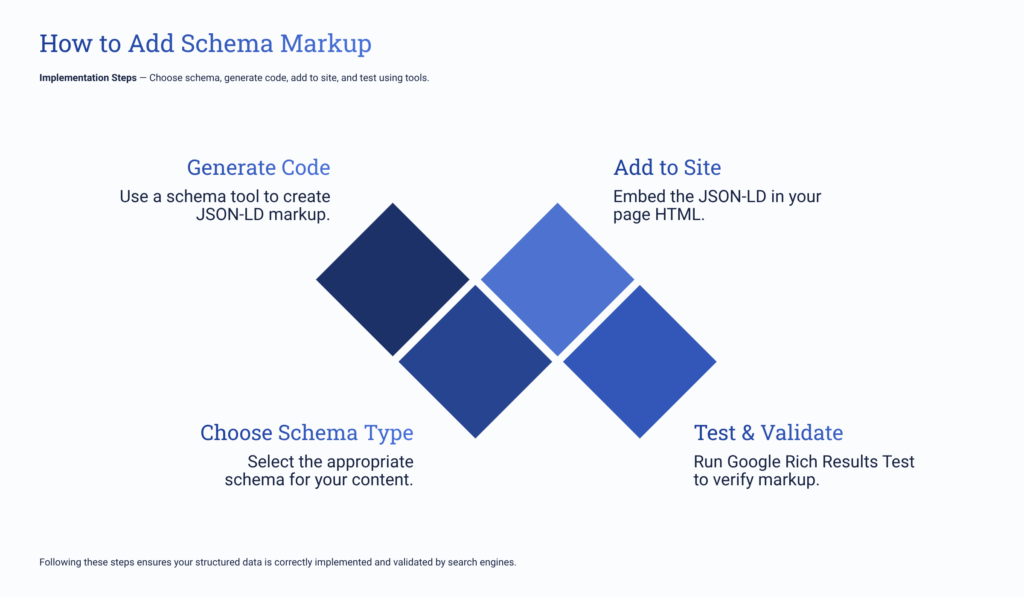
Step 1: Choose the Correct Schema Type
Match Schema with Content
Select the type of structured data that best fits your page.
Step 2: Generate the Code
Use Schema Generators or Plugins
You can use plugins or schema generators to create the required code easily.
Step 3: Add Schema to Your Website
Insert Code into HTML
Add the generated code to your page using JSON-LD, Microdata, or RDFa format.
Step 4: Test Your Structured Data
Validate Using Google Tools
Once you have added schema, test it using Google’s free validation tools to ensure it works correctly.
Testing confirms whether your page is eligible for rich results.
Benefits of Schema Markup
Schema markup improves the way your website appears in search results.
It helps your listing stand out.
Benefits include:
- Enhanced visual presentation
- Improved click-through rates
- Better user engagement
- Increased credibility
Although schema does not guarantee better rankings, it improves search appearance significantly.
Schema Markup and Rich Results
Rich results are enhanced listings generated using structured data.
They may display:
- Ratings
- Images
- FAQs
- Prices
- Availability
These features make your search result more informative.
Users are naturally drawn to listings that provide more detail.
Does Schema Markup Guarantee Higher Rankings?
Schema markup does not guarantee higher rankings.
However, it improves your search engine listing appearance.
Better appearance often leads to:
- Higher click-through rates
- Increased traffic
- Stronger user trust
These factors contribute positively to overall SEO performance.
Testing and Validation
After implementing schema, always validate your structured data.
Google provides free tools that allow you to:
- Check for errors
- Confirm eligibility for rich results
- Ensure correct formatting
Validation ensures your schema is functioning properly.
Best Practices for Schema Markup
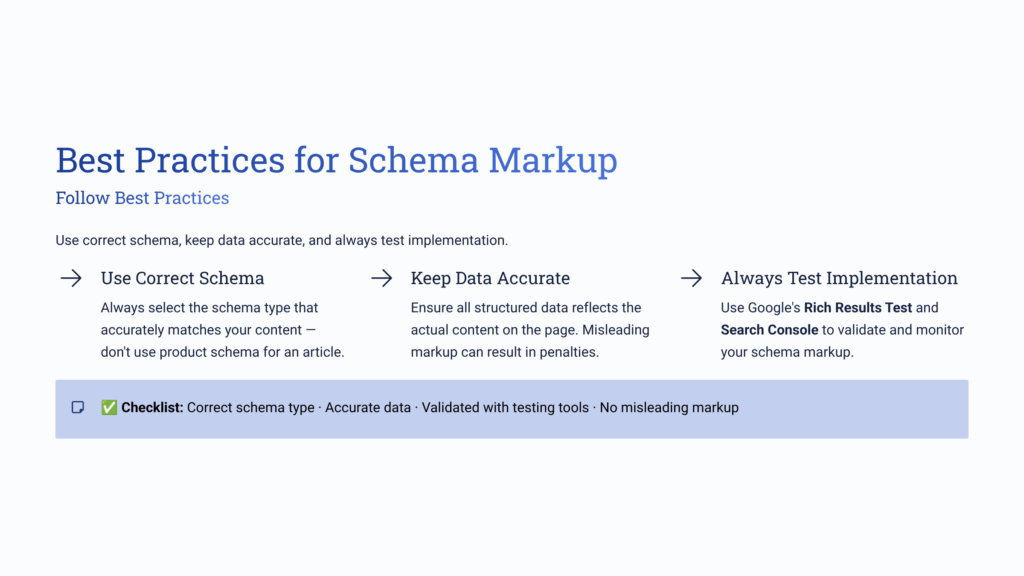
Follow these best practices:
- Use the correct schema type
- Avoid adding misleading structured data
- Keep information accurate and updated
- Follow Schema.org vocabulary standards
- Test after implementation
Proper implementation ensures maximum benefits.
Schema Markup and Search Visibility
Schema markup improves how your site appears in search engine results pages.
A visually enhanced listing attracts more attention.
More attention often leads to more clicks.
More clicks mean more traffic.
In competitive industries, this advantage can make a significant difference.
Final Summary: Small Code, Big Impact
To sum up, schema markup is a powerful SEO element that helps search engines understand your content better.
It is a type of structured data added to your HTML.
It does not directly improve rankings, but it enhances your search listing appearance.
When implemented correctly, schema markup:
- Improves visibility
- Increases click-through rates
- Enhances user trust
- Boosts traffic
Use JSON-LD whenever possible, test your structured data, and choose the correct schema type for your content.
Schema markup may be small in code, but it makes a big difference in how your website performs in search results.

Related Posts