
Have you ever wondered how Google shows the perfect result in seconds when you search for anything? It may seem instant and simple, but behind that quick response is a highly advanced and structured process.
In this article, we will explain exactly how search engines work. From crawling the internet to indexing web pages and finally ranking them in search results, we are covering it all in a clear and detailed way.
Understanding how search engines function is important for anyone who owns a website, runs a blog, or works in digital marketing. When you understand the system, you can optimize your website properly and improve your visibility in search results.
What Is a Search Engine?
A search engine is a software system that helps users find information on the internet. It acts as a bridge between users and the vast amount of information available online.
Popular examples of search engines include:
- Bing
- Yahoo

Their main job is to scan, store, and rank millions of web pages so users can quickly find the most relevant information based on their search query.
Without search engines, finding information online would be extremely difficult because users would have to manually browse websites one by one.
The Three Major Steps of Search Engines
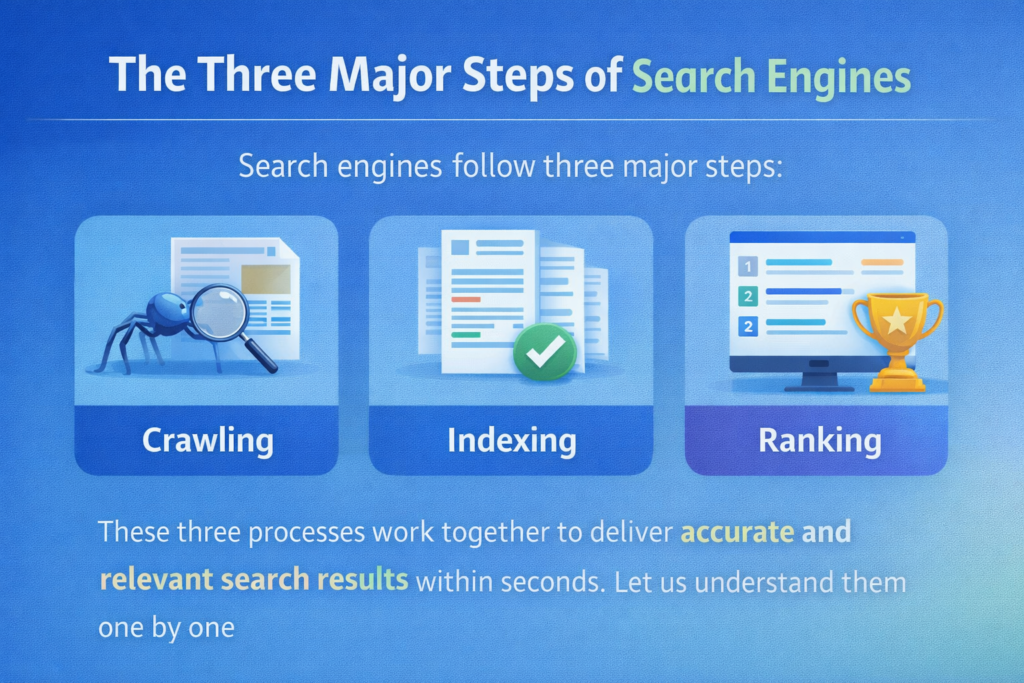
Search engines follow three major steps:
- Crawling
- Indexing
- Ranking
These three processes work together to deliver accurate and relevant search results within seconds. Let us understand them one by one in detail.
Step 1: Crawling
What Is Crawling?
Crawling is the first step in how search engines work. Search engines use automated programs called bots. These bots are also known as spiders or crawlers.
Their job is to scan the internet and discover new and updated web pages.
How Crawlers Work
Search engine bots follow links from one page to another. When they land on a webpage, they:
- Read the content
- Analyze the structure
- Identify links to other pages
- Move to the next connected page
This process continues continuously across the internet.
Crawlers help search engines discover new websites and updated content. If a website is not crawled, it cannot move to the next stage of indexing.
Step 2: Indexing
What Is Indexing?
After crawling comes indexing. Once bots scan your site, they store important data in the search engine’s library called the index.
You can think of the index as a digital filing cabinet. Instead of storing physical files, it stores information about web pages.
What Gets Stored in the Index?
When a page is indexed, search engines store details such as:
- Page content
- Keywords
- Titles and headings
- Images
- Internal and external links
Only pages that are indexed can appear in search results. If a page is not indexed, it will not rank, no matter how good the content is.
Step 3: Ranking
What Is Ranking?
Ranking is the final step. When someone searches for a keyword, the search engine picks the most relevant pages from its index.
It then ranks them based on more than 200 factors to decide the order in which they appear.
How Ranking Works
When a user enters a search query:
- The search engine reads the query.
- It searches its index for matching pages.
- It evaluates those pages using multiple ranking factors.
- It displays the results in order of relevance on the search engine results page (SERP).
This entire process happens within seconds.
Real-World Example of How Search Engines Work
Let us take a real-world example.
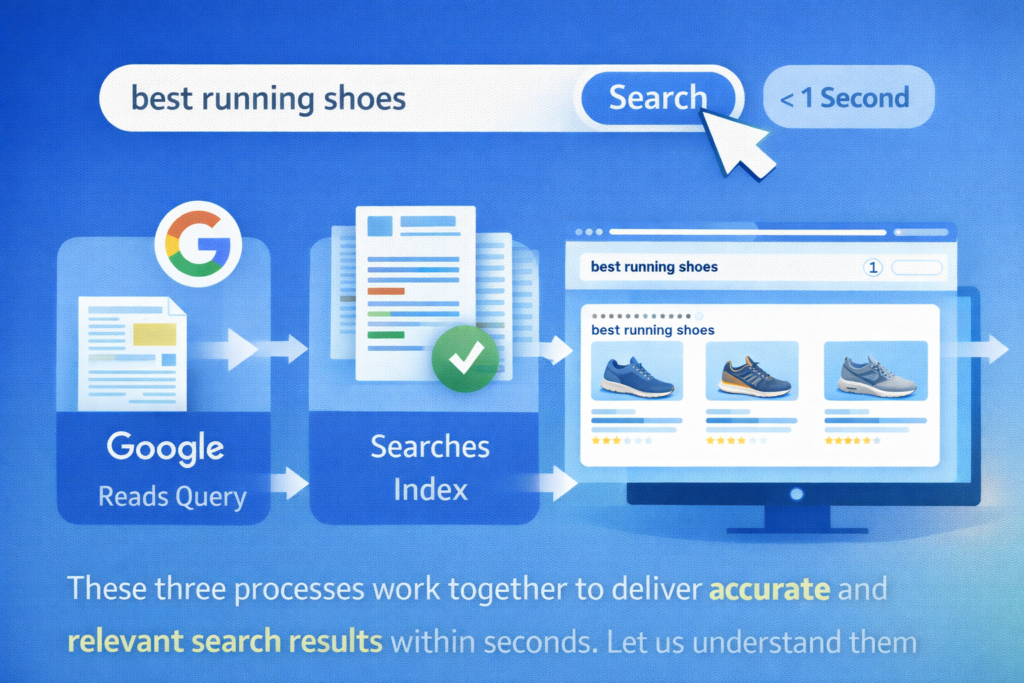
You type “best running shoes” into Google. Within a second:
- Google reads your query.
- It searches its index.
- It ranks the most relevant results.
- It shows them on the SERP.
This quick response is possible because crawling and indexing have already been completed before you performed the search.
What Makes One Page Rank Above Another?
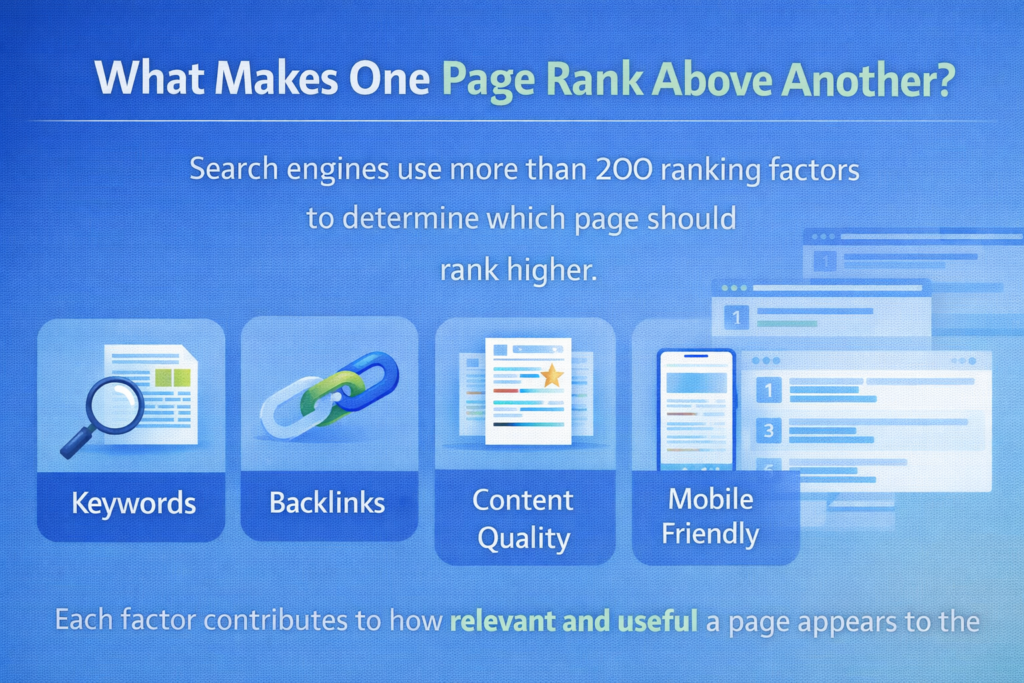
Search engines use more than 200 ranking factors to determine which page should rank higher.
Some of the key factors include:
- Keywords
- Backlinks
- Content quality
- Mobile friendliness
- Page speed
Each factor contributes to how relevant and useful a page appears to the search engine.
Keywords
Keywords help search engines understand what your content is about. If your page includes relevant keywords naturally, it improves the chances of ranking for related queries.
Backlinks
Backlinks are links from other websites pointing to your site. They act as votes of confidence. The more quality backlinks a page has, the more authority it gains.
Content Quality
High-quality, informative, and original content ranks better. Search engines prioritize content that provides value to users.
Mobile Friendliness
Since many users search on mobile devices, search engines prefer websites that are mobile-friendly and responsive.
Page Speed
Fast-loading pages provide a better user experience. Slow websites often rank lower because they negatively impact usability.
Understanding the Search Engine Results Page (SERP)
When you search for something, the results appear on what is called the Search Engine Results Page (SERP).
Paid Results
At the top of the search results, you may see listings marked as “Ad.” These are paid search results.
Businesses pay the search engine for these positions.
Organic Results
Below the ads, you will find organic results. These are ranked naturally through search engine optimization (SEO).
Organic results do not require payment per click. Instead, they earn their position based on relevance and optimization.
How to Make Your Website Appear in Search Results
If you want your website to show up in search results, there are two essential requirements.
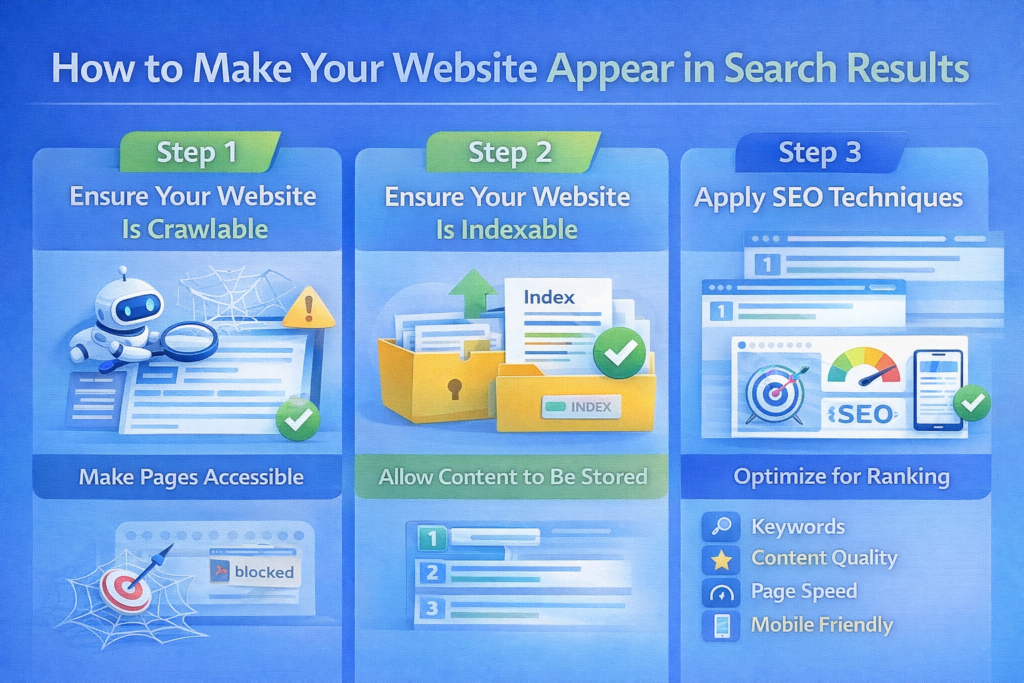
Step 1: Ensure Your Website Is Crawlable
Make Pages Accessible
Search engine bots must be able to access your website. If your site blocks crawlers, it cannot move to indexing.
Step 2: Ensure Your Website Is Indexable
Allow Search Engines to Store Your Content
Your pages must be allowed to enter the search engine’s index. Without indexing, ranking is impossible.
Step 3: Apply SEO Techniques
Optimize for Ranking
After crawling and indexing, you must apply SEO techniques such as:
- Using relevant keywords
- Improving content quality
- Increasing page speed
- Making your site mobile-friendly
These optimizations improve your chances of ranking higher.
Why Search Engines Are Fast and Powerful
Search engines process billions of searches every day. Despite this massive volume, they deliver results almost instantly.
They achieve this because:
- Crawling and indexing happen continuously.
- The index is organized efficiently.
- Ranking algorithms are highly advanced.
The system is complex, but the user experience remains simple and fast.
Final Summary: How Search Engines Work
To sum up, search engines work by:
- Crawling the web using bots.
- Indexing content in a digital library.
- Ranking pages based on what is most useful to the searcher.
This process is fast, complex, and powerful. It allows users to find relevant information within seconds.
Understanding how search engines work helps website owners and marketers improve their online visibility. When you ensure your site is crawlable, indexable, and properly optimized, you increase your chances of appearing in search results.
Search engines are not just tools. They are intelligent systems designed to deliver the most relevant answers to users quickly and efficiently.

Related Posts