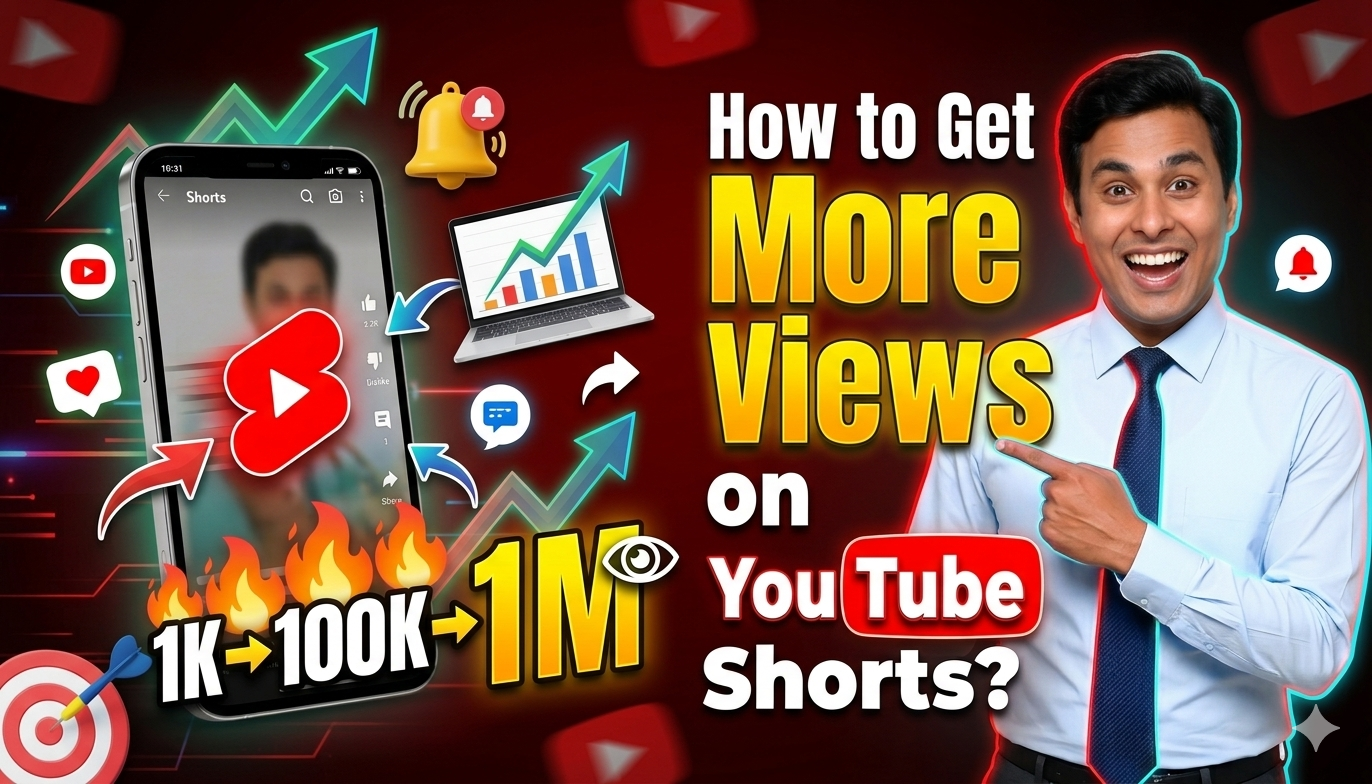
Getting more views on YouTube Shorts has become one of the biggest challenges for content creators today. Many creators consistently upload Shorts with the expectation that their content will eventually go viral. However, what they often experience is a completely different reality. A video may receive an initial burst of views—sometimes a few hundred or even a few thousand—but after that, the growth suddenly stops. The graph becomes flat, and no additional reach is generated.
This situation can be confusing and discouraging. Creators start questioning their content quality, editing skills, or even the platform itself. Some believe that the algorithm is unfair or inconsistent. However, the truth is that YouTube Shorts follows a structured system. The algorithm is not random; it evaluates content based on specific performance signals.
If you understand how this system works and what factors influence growth, you can significantly improve your results. Instead of guessing or relying on luck, you can take a strategic approach. This article explains in detail how YouTube Shorts works, why videos stop growing, and what exact steps you can take to get more views consistently.
How YouTube Shorts Algorithm Works

The Role of Seed Audience
When you upload a YouTube Short, the platform does not immediately distribute it to a large audience. Instead, it starts with a testing phase. During this phase, your video is shown to a small group of viewers known as the seed audience.
This seed audience is selected randomly. This means that the people who first see your video may or may not be your ideal target audience. YouTube uses this random group because it does not yet fully understand your content. It needs initial data to decide how your video performs.
The purpose of this stage is to analyze how viewers react to your content. The algorithm observes their behavior closely. It checks whether viewers watch the video, skip it, rewatch it, or interact with it. Based on this data, YouTube decides whether your video deserves more exposure.
Initial Testing Phase
During the initial testing phase, your video is evaluated based on real user behavior. This is one of the most important stages for getting more views on YouTube Shorts.
If viewers in the seed audience watch your video completely, it sends a strong positive signal to the algorithm. If they rewatch it or engage with it, the signal becomes even stronger. This tells YouTube that your content is interesting and valuable.
On the other hand, if viewers quickly swipe away from your video, the algorithm receives a negative signal. It assumes that your content is not engaging enough. As a result, the distribution slows down or stops entirely.
This phase determines whether your video will grow or fail. That is why optimizing your content for this stage is crucial.
Why Shorts Stop Getting Views
One of the most common problems creators face is that their Shorts stop getting views after an initial spike. This usually happens because the video does not perform well during the testing phase.
If the seed audience does not engage with your video, YouTube reduces its reach. Even if your content has potential, it may not reach the right audience because the initial signals were weak.
However, if the seed audience responds positively, the algorithm expands your reach. It starts showing your video to more people who have similar interests. If this new audience also engages well, the process continues, and your video can grow rapidly.
This is why some Shorts go viral while others stop at low views. The difference lies in how the audience reacts during the early stages.
Difference Between Shorts and Long Videos
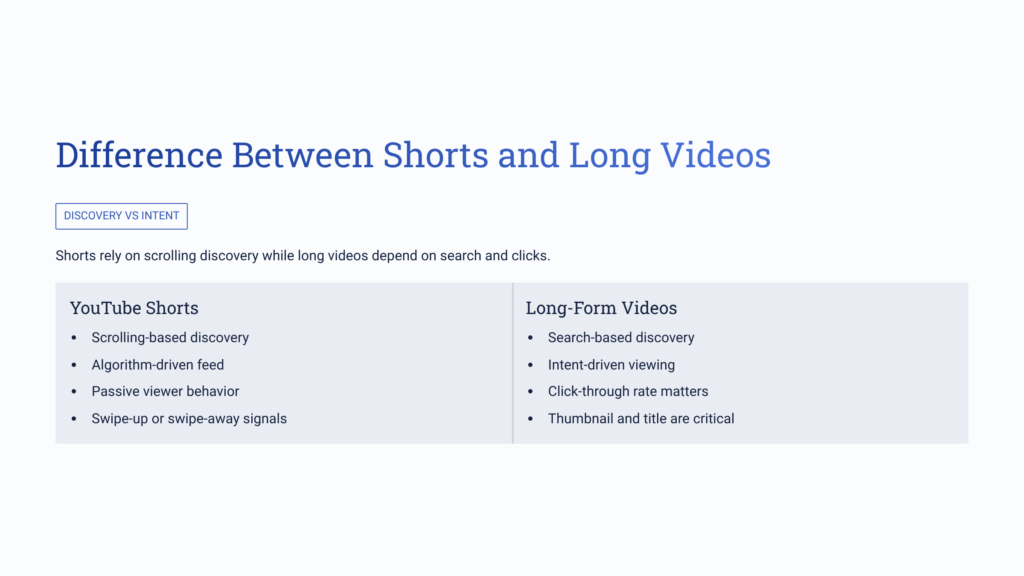
Intent vs Discovery
To get more views on YouTube Shorts, it is important to understand how Shorts differ from long-form videos.
In long-form content, viewers actively search for videos. They type queries, browse thumbnails, and select videos based on their interests. This is called intentional viewing.
In contrast, Shorts are based on discovery. Users scroll through a feed where videos are automatically shown to them. They do not actively search for content. Instead, they decide within seconds whether to continue watching or skip.
This difference changes everything. In Shorts, you do not get a second chance to impress the viewer. You must capture attention instantly.
Algorithm Behavior Difference
Because Shorts and long videos work differently, their algorithms also function differently.
In long videos, metrics like click-through rate (CTR) and thumbnails play a major role. However, Shorts do not rely on thumbnails. Instead, the algorithm focuses on viewer behavior within the first few seconds.
This means that your content must immediately grab attention. If it fails to do so, viewers will swipe away, and your video will not perform well.
Understanding this difference is essential if you want to increase views on Shorts.
Key Metrics That Help You Get More Views on YouTube Shorts
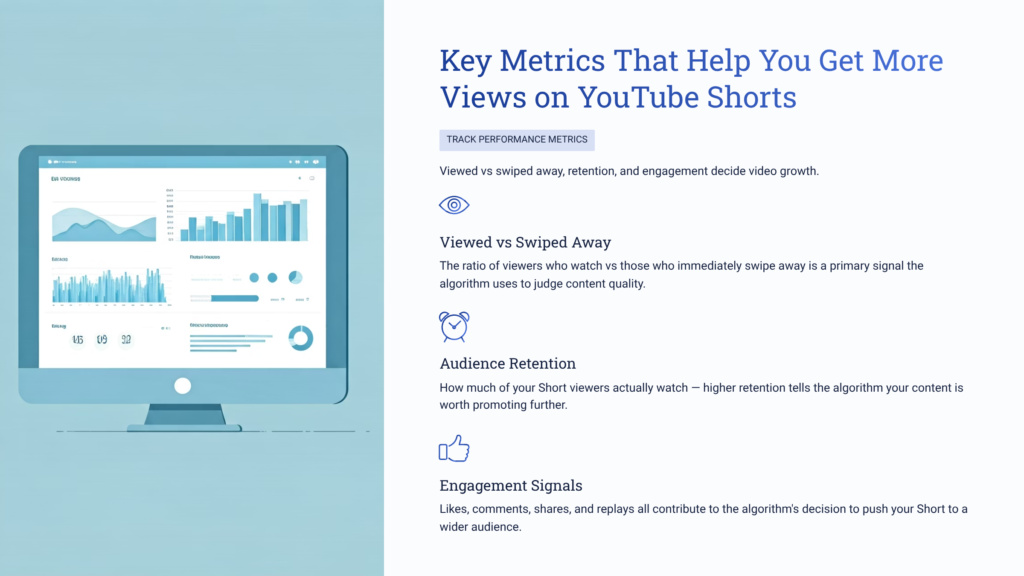
Viewed vs Swiped Away
The most important metric for Shorts is “viewed vs swiped away.” This metric shows how many people chose to watch your video versus how many skipped it.
If a large percentage of viewers watch your video, it indicates strong performance. The algorithm then pushes your video to more users.
If most viewers swipe away, it signals poor performance. As a result, your video’s reach decreases.
Improving this metric is one of the most effective ways to get more views.
Importance of Viewer Intent
Not every impression becomes a view. YouTube measures whether the viewer intentionally watched your video.
If someone scrolls too quickly, it may not count as a meaningful view. This means your content must be engaging enough to make viewers stop and watch.
The more intentional views your video receives, the better it performs.
Ideal Performance Range
High-performing Shorts usually have a strong viewed percentage. While exact numbers may vary, better-performing videos consistently show higher engagement levels.
Instead of focusing on exact percentages, the goal should be to continuously improve viewer retention and engagement.
How to Improve Viewed vs Swiped Away Ratio
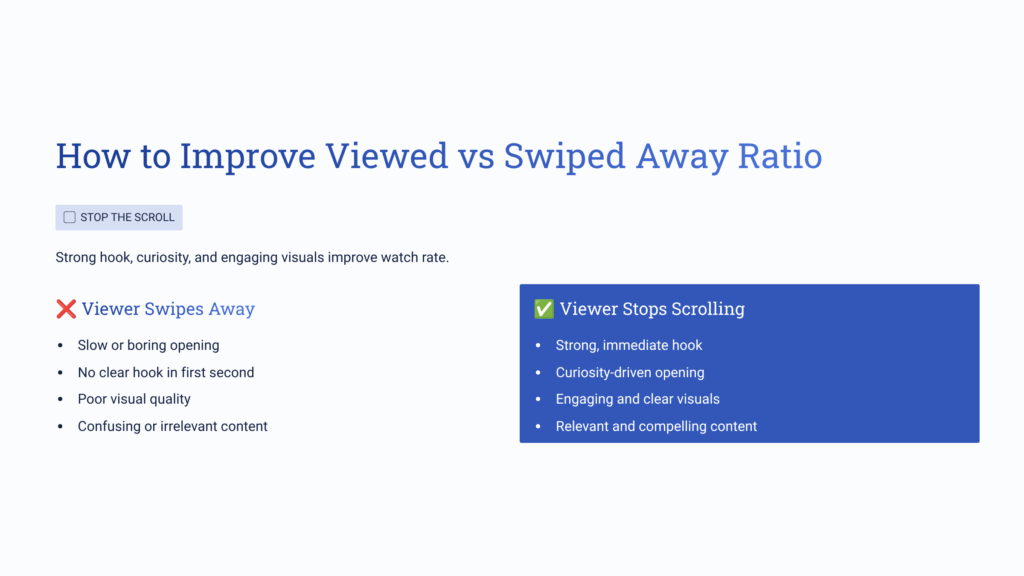
Focus on the First 3 Seconds
The first 3 seconds of your Short are the most critical. This is the moment when viewers decide whether to stay or leave.
If your video fails to grab attention immediately, viewers will swipe away. This reduces your viewed percentage and limits your reach.
A strong opening increases the chances of viewers staying, which improves performance.
Create a Strong Hook
A hook is what captures attention at the beginning of your video. It can be a question, a surprising statement, or something visually engaging.
The purpose of a hook is to stop the viewer from scrolling. Without a strong hook, even high-quality content may not perform well.
Build Curiosity
Curiosity is a powerful tool for increasing views. When viewers feel curious, they are more likely to watch the entire video.
This improves retention and sends positive signals to the algorithm.
Curiosity can be created through storytelling, suspense, or unexpected elements.
Use Visual Hooks
Visual hooks are elements that instantly grab attention. Unique visuals, unusual actions, or creative scenes can make viewers stop scrolling.
These elements help improve engagement and increase your chances of getting more views.
The Role of Audience Retention
Why Retention is Critical
Audience retention measures how much of your video viewers watch. In Shorts, this metric is extremely important.
Higher retention means viewers are engaged, which increases the likelihood of your video being promoted.
High Retention = More Views
Videos with high retention are more likely to be pushed to a larger audience.
When viewers watch your video completely, it signals strong engagement. This helps your video grow.
Rewatch Value
Rewatching is a powerful signal. If viewers watch your video multiple times, it indicates high interest.
This significantly increases your chances of getting more views.
Best Length for YouTube Shorts

No Fixed Ideal Length
There is no fixed ideal length for Shorts. The best length depends on your content.
Content-Driven Length Strategy
Your video should be as long as necessary to deliver value, but short enough to maintain attention.
Storytelling vs Quick Content
Some Shorts work better as quick clips, while others benefit from storytelling.
The key is to keep viewers engaged throughout the video.
Conclusion
Getting more views on YouTube Shorts requires understanding how the algorithm works and optimizing your content accordingly.
By focusing on the first few seconds, improving retention, and creating engaging content, you can increase your reach significantly.
When these strategies are applied consistently, your Shorts can grow faster and reach a larger audience over time.

Related Posts