Welcome to this article. Today we are going to talk about content readability, a crucial factor in SEO that is often ignored. Whether you are a blogger, business owner, or SEO expert, readability directly impacts how long people stay on your site and how search engines rank your content.
Many websites focus only on keywords and backlinks but overlook readability. However, even well-optimized content may fail if it is difficult to read. Search engines aim to provide useful and user-friendly content, and readability plays an important role in achieving that goal.
When content is easy to understand, visitors stay longer on the website and interact more with the content. This improves user experience and strengthens SEO performance. Understanding content readability helps create content that works well for both users and search engines.
What is Content Readability?
Readability means how easy it is for someone to read and understand your content. It depends on how clearly ideas are explained and how easily readers can move through the content.
Good readability makes content simple and clear without losing meaning. Readers should be able to understand the message without difficulty.
If content is hard to read, people leave the page quickly, and that tells Google your content is not helpful. Poor readability creates a negative experience for visitors and reduces the effectiveness of the content.
Readable content improves communication by making information easier to understand. It also helps users find answers quickly, which improves satisfaction and engagement.
Why Content Readability is Important for SEO
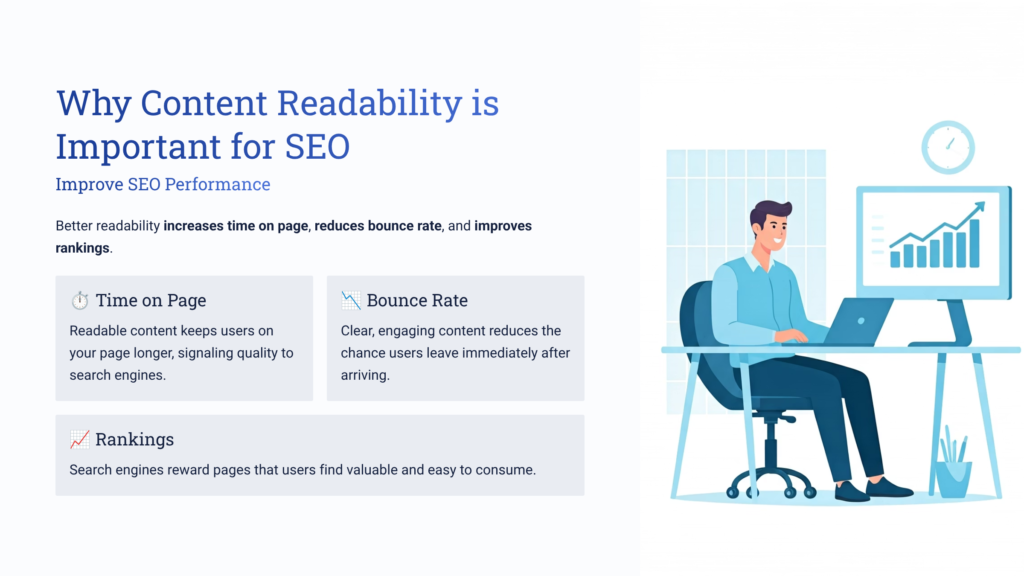
Search engines like Google want to show helpful and user-friendly content. If your page is easy to read, users stay longer, bounce rate drops, and engagement goes up. All of these are positive SEO signals.
Readable content improves the chances of users staying on your website and exploring more pages. When users spend more time on a page, it signals that the content is useful.
Search engines consider user behavior when evaluating content quality. Pages with strong engagement signals often perform better in search results.
Readable content helps:
- Improve user engagement
- Reduce bounce rate
- Increase time on page
- Improve SEO performance
Clear and well-structured content provides a better experience for visitors and improves search rankings.
Factors That Affect Content Readability
Several things affect how readable your content is. Understanding these factors helps improve writing quality and user experience.
Sentence Length
Sentence length plays an important role in readability. Short sentences are easier to understand than long and complex sentences.
Long sentences can confuse readers and make content harder to follow. Breaking long sentences into shorter ones improves clarity.
Simple sentences make information easier to understand.
Word Choice
Word choice affects how easily readers understand content. Simple and familiar words improve readability.
Complicated words and technical language can make content difficult to understand.
Clear and simple language helps communicate ideas effectively.
Paragraph Size
Paragraph size affects readability. Short paragraphs are easier to read than long blocks of text.
Large paragraphs can look overwhelming and discourage readers from continuing.
Short paragraphs improve readability and make content easier to scan.
Headings
Headings help organize content into sections. They make it easier for readers to find information.
Clear headings improve navigation and structure.
Well-organized content improves readability.
Formatting
Formatting improves readability by making content visually clear.
Formatting includes:
- Bullet points
- Bold text
- Spacing
- Lists
Good formatting makes content easier to scan and understand.
Tools to Measure Content Readability
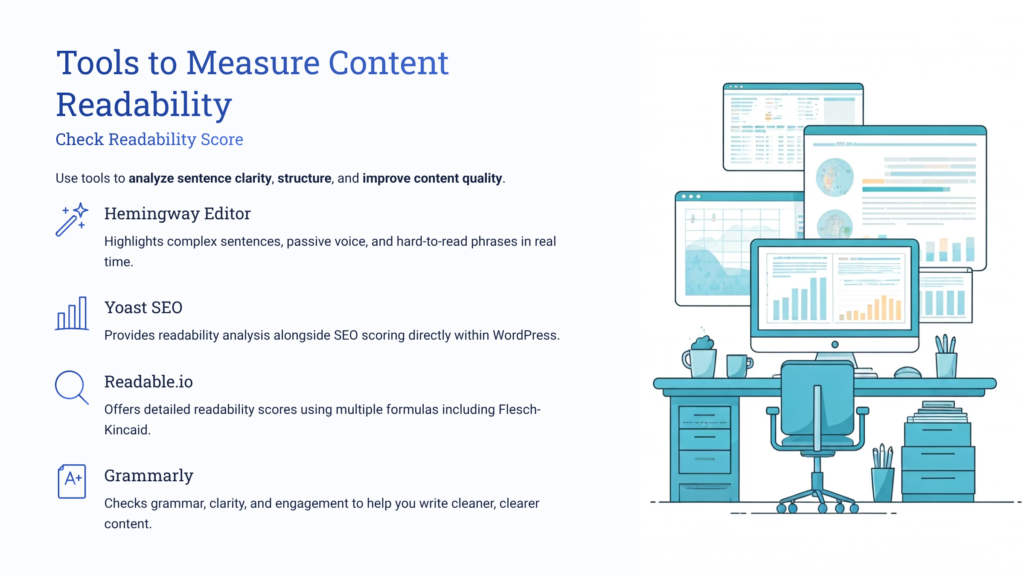
You can measure content readability using tools like Hemingway Editor, Yoast SEO, or Grammarly. These tools help evaluate how easy your content is to read.
Readability tools provide suggestions to improve writing clarity and structure.
They analyze sentence length, word difficulty, and paragraph structure.
These tools give you scores like Flesch Reading Ease Score to help you optimize your writing.
Readability scores help identify areas that need improvement.
Using readability tools helps maintain consistent content quality.
Ideal Reading Level for Website Content
For general website content, aim for a reading level of grade 6 to 8. This does not mean you are writing for children. It means your message is clear and accessible to more people.
Lower reading levels make content easier to understand for a wide audience.
Clear content improves communication and user experience.
Writing at an appropriate reading level helps reach more readers.
Simple language improves engagement.
Readable content is useful for both beginners and experienced readers.
Content Readability Best Practices
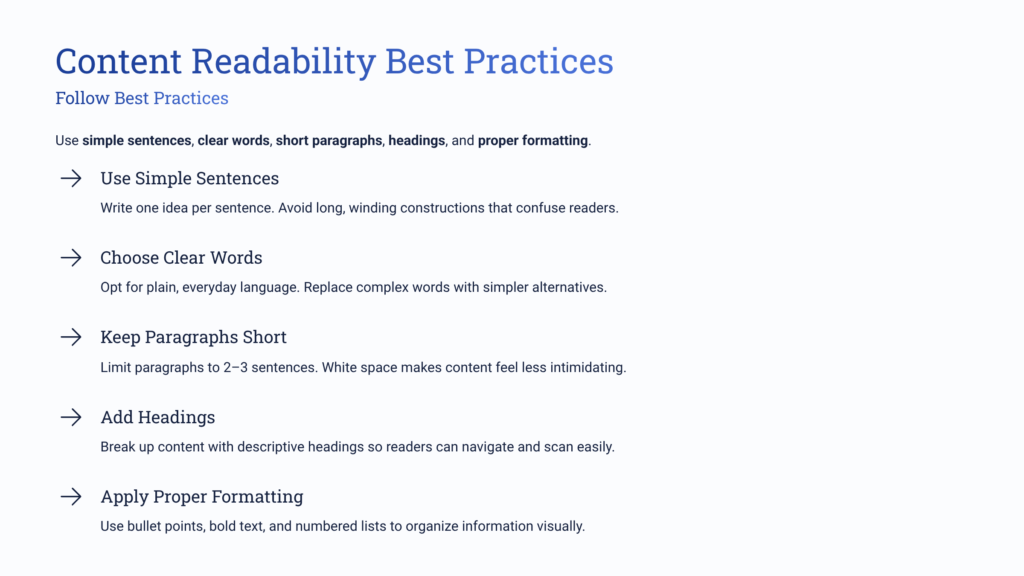
Let’s take a quick look at the best practices to keep your content readable and SEO-friendly.
Step 1: Write Simple Sentences
Use short and simple sentences whenever possible. Simple sentences improve clarity and make content easier to understand.
Avoid complicated sentence structures.
Clear sentences improve communication.
Step 2: Use Clear Words
Use simple and familiar words. Clear words make content easier to read.
Avoid unnecessary technical terms.
Simple vocabulary improves readability.
Step 3: Use Short Paragraphs
Use short paragraphs to make content easier to read.
Short paragraphs improve scanning and readability.
Large text blocks reduce readability.
Step 4: Use Proper Headings
Use headings to organize content clearly.
Headings help readers find information quickly.
Clear structure improves readability.
Step 5: Use Proper Formatting
Use formatting to improve readability.
Formatting makes content visually clear and organized.
Lists and spacing improve reading experience.
Poor Readability and SEO
If your content is hard to read, users bounce off quickly. That tells search engines your content is unhelpful and your ranking can drop.
Poor readability reduces engagement and increases bounce rates.
Search engines interpret poor engagement as a sign of low-quality content.
Improving readability helps improve SEO performance.
Readable content keeps users engaged longer.
Better engagement improves ranking potential.
Content Readability Example
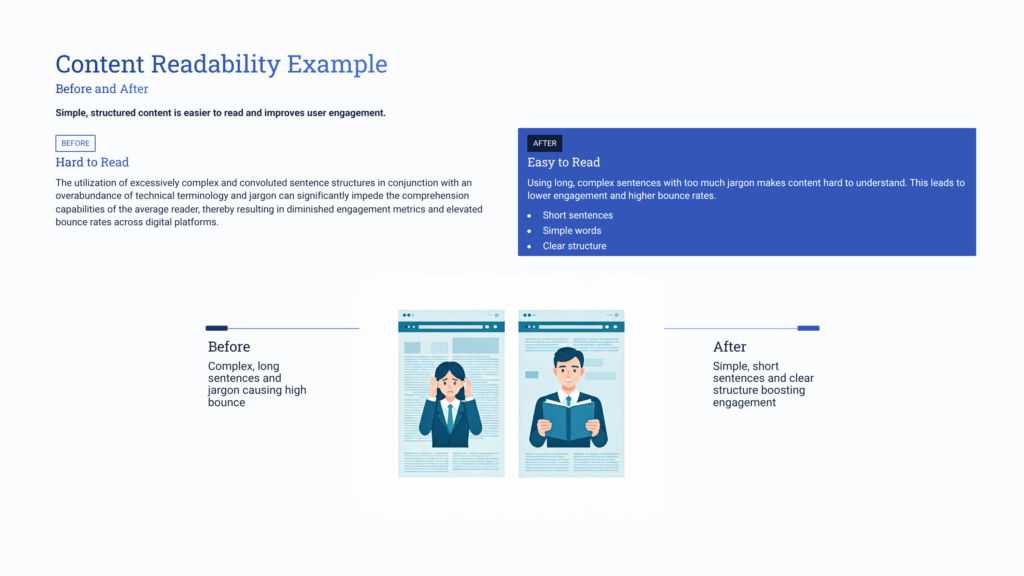
Here is a simple example.
On the left, you see a block of text that is hard to read. On the right, the same content has been simplified for better readability.
The simplified version uses shorter sentences and clearer structure.
Most readers prefer content that is easy to read and understand.
Readable content improves user experience and engagement.
Conclusion
To summarize, content readability is a key factor for keeping your users engaged and improving your SEO performance.
Readable content helps users understand information quickly and easily. When users stay longer on your website, it sends positive signals to search engines.
Write simply, clearly, and with your reader in mind. That is the secret to success.

Related Posts