
Welcome. In this article, we will explain an often overlooked but powerful SEO element: breadcrumbs. If you are trying to improve website navigation and search visibility, breadcrumbs can be a very effective solution.
Breadcrumbs help users understand where they are within a website and allow them to navigate easily between pages. They also help search engines understand how pages are organized within a website.
Many websites focus on content and keywords but ignore navigation structure. Breadcrumbs improve both user experience and search engine optimization by providing a clear path through a website.
Breadcrumbs are simple to implement and can make a significant difference in both usability and search performance.
What Are Breadcrumbs?
In web design, breadcrumbs are navigation links that show users where they are within a website’s structure.
They act like a digital trail that helps users move back to the homepage or previous pages. Breadcrumb navigation shows the path from the homepage to the current page.
A typical breadcrumb example looks like this:
Home > Blog > SEO > Breadcrumbs
Each part of the breadcrumb path is clickable, allowing users to move to higher-level pages without using the main menu.
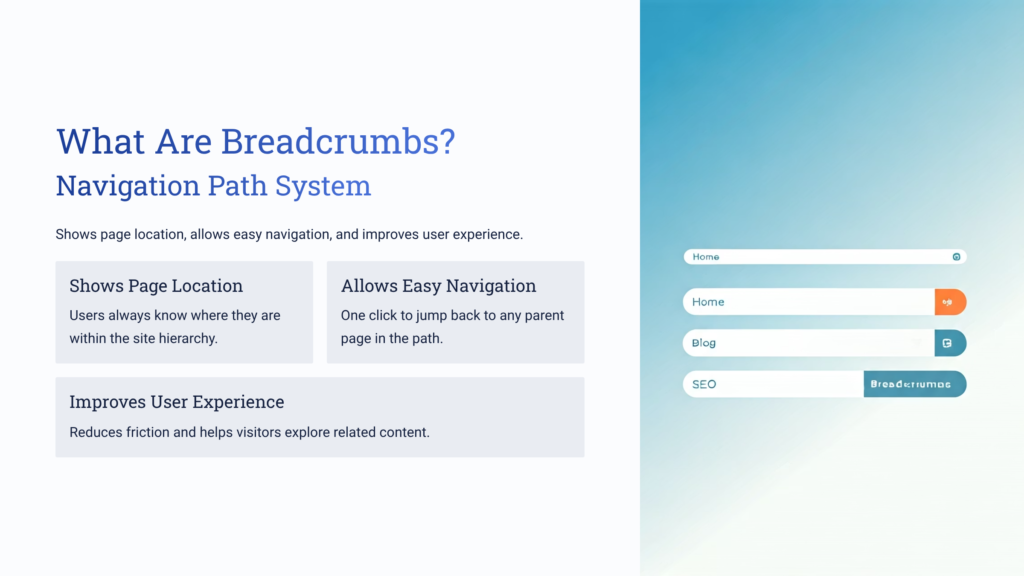
Breadcrumbs improve navigation by making it easier for users to understand the structure of a website.
They are especially useful for websites that have many pages and categories.
Breadcrumbs help users:
- Understand page location
- Navigate easily
- Move between categories
- Return to previous pages
Breadcrumb navigation provides a clear structure that improves usability.
Types of Breadcrumbs
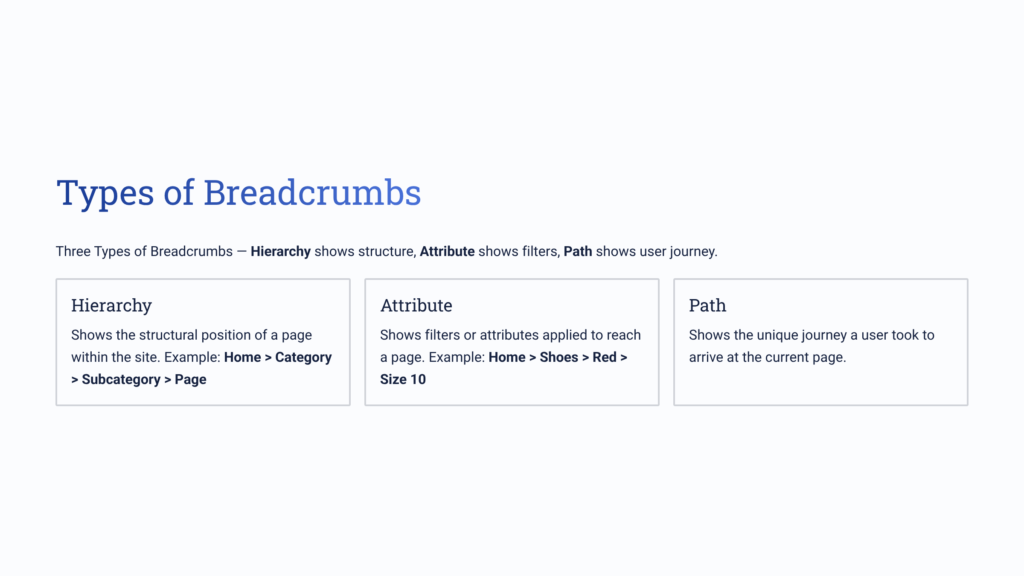
There are three main types of breadcrumbs. Each one has a different function based on your site structure.
Different websites use different breadcrumb types depending on how their content is organized.
Hierarchy-Based Breadcrumbs
Hierarchy-based breadcrumbs show the position of a page within the website structure.
They follow the structure from the homepage to the current page.
Example:
Home > Category > Subcategory > Page
This is the most commonly used breadcrumb type.
Hierarchy-based breadcrumbs help users understand the relationship between pages.
They are ideal for websites with categories and subcategories.
Attribute-Based Breadcrumbs
Attribute-based breadcrumbs are commonly used on e-commerce websites.
They display product attributes or filters selected by users.
Example:
Home > Shoes > Running Shoes > Size 9 > Black
These breadcrumbs help users understand product filtering options.
They make it easier for users to adjust filters and explore products.
Path-Based Breadcrumbs
Path-based breadcrumbs show the actual path a user followed to reach a page.
They depend on the user’s navigation history.
Example:
Home > Blog > SEO Tools > Keyword Research
This breadcrumb type changes based on the user’s journey.
Path-based breadcrumbs are less commonly used because they can be inconsistent.
Why Breadcrumbs Are Important for SEO
Breadcrumbs are not just for users. They help Google understand your site hierarchy, distribute link equity, and enhance how your pages appear in search results.
Search engines analyze breadcrumbs to understand how pages are connected.
Breadcrumbs help search engines:
- Understand site structure
- Identify page relationships
- Distribute link equity
- Improve crawling
Breadcrumb links create additional internal linking, which strengthens website structure.
Better structure makes it easier for search engines to index pages correctly.
Breadcrumbs also improve page organization and make websites easier to understand.
Breadcrumbs in Search Results
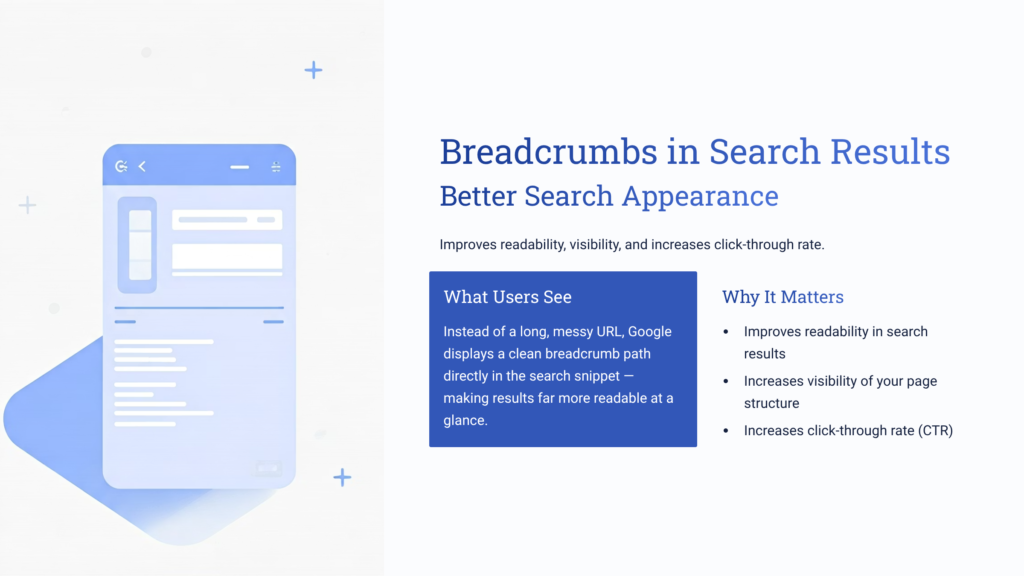
Google often displays breadcrumb paths in search listings, replacing the traditional URL.
Instead of showing long URLs, Google may show breadcrumb navigation paths in search results.
This makes search results easier to read.
Breadcrumb paths help users understand what the page is about before clicking.
Clear breadcrumb paths improve search appearance and usability.
Breadcrumb display in search results makes listings more attractive.
This improves the CTR (click-through rate).
Higher click-through rates help improve search performance.
Where to Place Breadcrumbs
Breadcrumbs are usually placed below the header and above the page content.
This location makes breadcrumbs easy to see without interfering with the main content.
Users can quickly identify their position on the website.
Breadcrumb placement should be consistent across all pages.
Breadcrumbs should be visible but not distracting.
Proper placement improves navigation and usability.
Websites That Benefit from Breadcrumbs
Breadcrumbs are ideal for blogs, e-commerce sites, and any website with multi-level navigation.
Websites with many pages benefit the most from breadcrumb navigation.
Breadcrumbs are especially useful for:
- Blog websites
- E-commerce websites
- Educational websites
- Large business websites
- Content-rich websites
Multi-level navigation becomes easier with breadcrumbs.
Users can quickly move between categories and pages.
Breadcrumbs simplify complex website structures.
Adding Breadcrumbs in WordPress
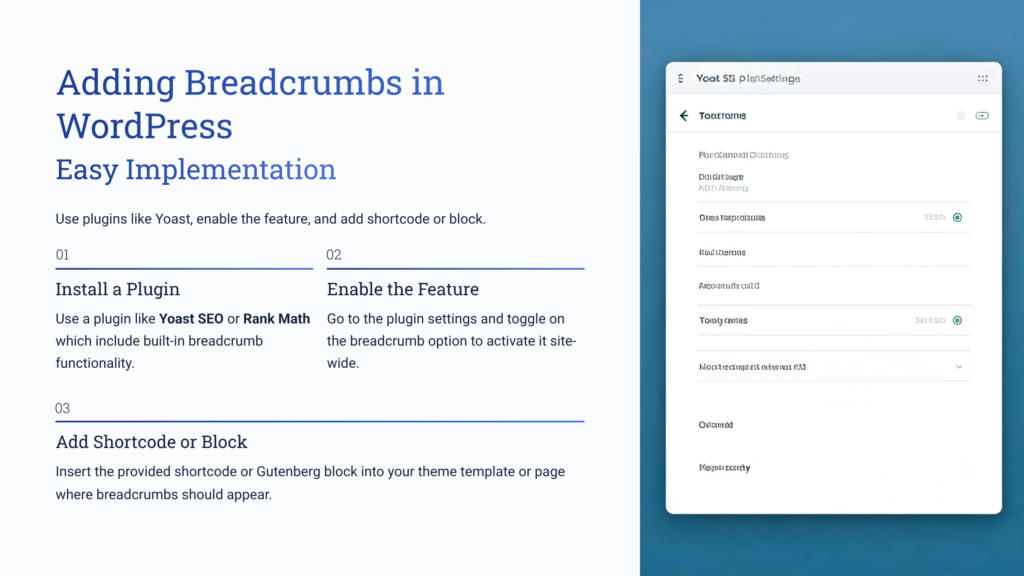
If you are using WordPress, the Yoast SEO plugin makes it easy to add breadcrumbs.
Breadcrumbs can be added without advanced technical knowledge.
WordPress plugins simplify breadcrumb implementation.
Steps to Add Breadcrumbs Using Yoast SEO
Step 1: Enable Breadcrumb Feature
Enable the breadcrumb feature in the Yoast SEO plugin settings.
The plugin includes built-in breadcrumb functionality.
Once enabled, breadcrumbs become available for use.
Step 2: Add Shortcode or Block
Paste a shortcode or add a block where breadcrumbs are needed.
Breadcrumbs can be added to:
- Pages
- Blog posts
- Templates
Shortcodes allow flexible placement.
Blocks allow easy visual editing.
Breadcrumb Schema Markup
When you enable breadcrumbs through Yoast or manually, they also add schema markup which helps Google display breadcrumbs in rich results.
Schema markup provides structured data to search engines.
Structured data helps search engines understand breadcrumb paths.
Breadcrumb schema allows search engines to display navigation paths correctly.
Schema markup improves search result appearance.
Structured breadcrumbs improve visibility in search results.
Breadcrumb Best Practices
To get the most out of breadcrumbs, follow a few best practices.
Proper breadcrumb implementation improves both usability and SEO.
Make Breadcrumbs Clear
Breadcrumbs should be easy to understand.
Users should immediately recognize the page structure.
Clear labels improve navigation.
Simple breadcrumb names work best.
Avoid Duplicate Links
Do not duplicate breadcrumb links unnecessarily.
Duplicate links may confuse users and search engines.
Each breadcrumb link should represent a unique level.
Clean breadcrumb paths improve structure.
Make Breadcrumbs Mobile Friendly
Breadcrumbs should work properly on mobile devices.
Mobile users should be able to tap breadcrumb links easily.
Responsive breadcrumbs improve user experience.
Mobile-friendly design improves usability.
Conclusion
To sum it up, breadcrumbs improve navigation, user experience, and SEO.
They help users understand website structure and move easily between pages.
Breadcrumbs help search engines understand page relationships and website hierarchy.
They are easy to add and can make a big difference in both rankings and usability.
Proper breadcrumb implementation improves website structure and search visibility.
Breadcrumb navigation is a simple but powerful SEO feature that supports long-term website growth.

Related Posts