
Hello and welcome. In this article, we will break down a very important SEO concept: the difference between short tail and long tail keywords. If you want to improve your website’s visibility and attract the right audience, understanding these keyword types is essential.
Keywords are the foundation of search engine optimization. They help search engines understand your content and connect it with users searching for related information. Choosing the right type of keyword can directly impact your traffic, rankings, and conversions.
What Are Short Tail Keywords?
Short tail keywords are usually one to two words long and cover broad topics. Examples include:
- Shoes
- Laptop
- Digital marketing
These keywords are general and have a wide meaning. Because they are broad, they attract a large number of searches.
Characteristics of Short Tail Keywords
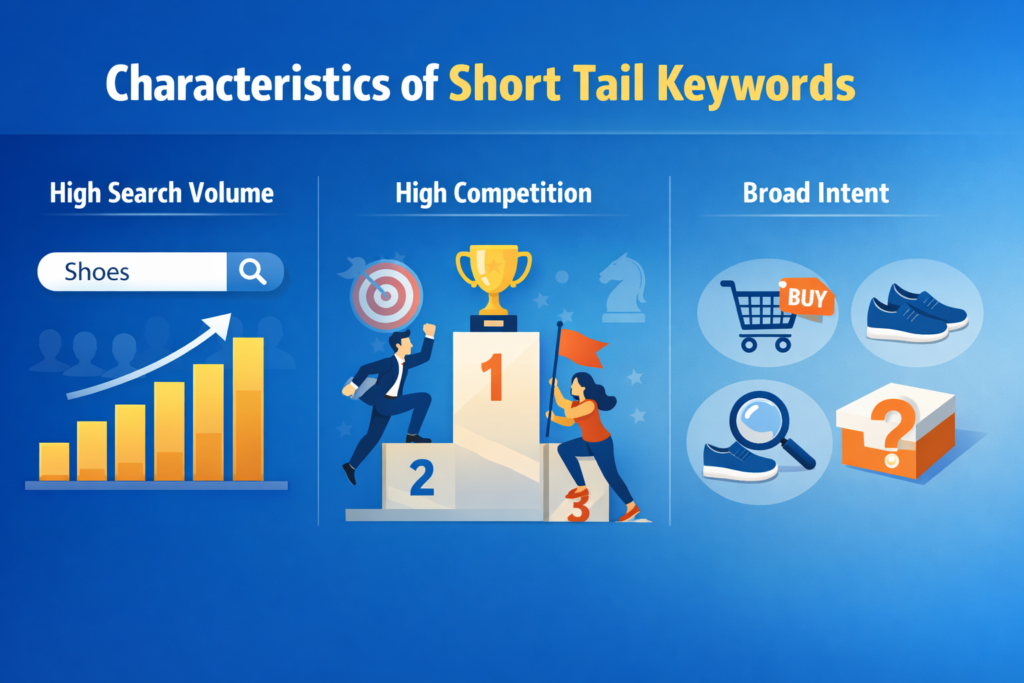
High Search Volume
Short tail keywords typically have high search volume. Many users search for these broad terms daily.
High Competition
Since these keywords are popular, many websites compete to rank for them. This makes ranking difficult, especially for new or small websites.
Broad Intent
Short tail keywords often do not clearly define user intent. For example, someone searching “shoes” may want to buy, compare, learn about brands, or simply browse.
What Are Long Tail Keywords?
Long tail keywords are longer phrases, usually three or more words, and they are more specific.
For example:
- Best budget laptop for a student in India
- Affordable sport shoes for men in India
These keywords focus on detailed user intent and specific needs.
Characteristics of Long Tail Keywords
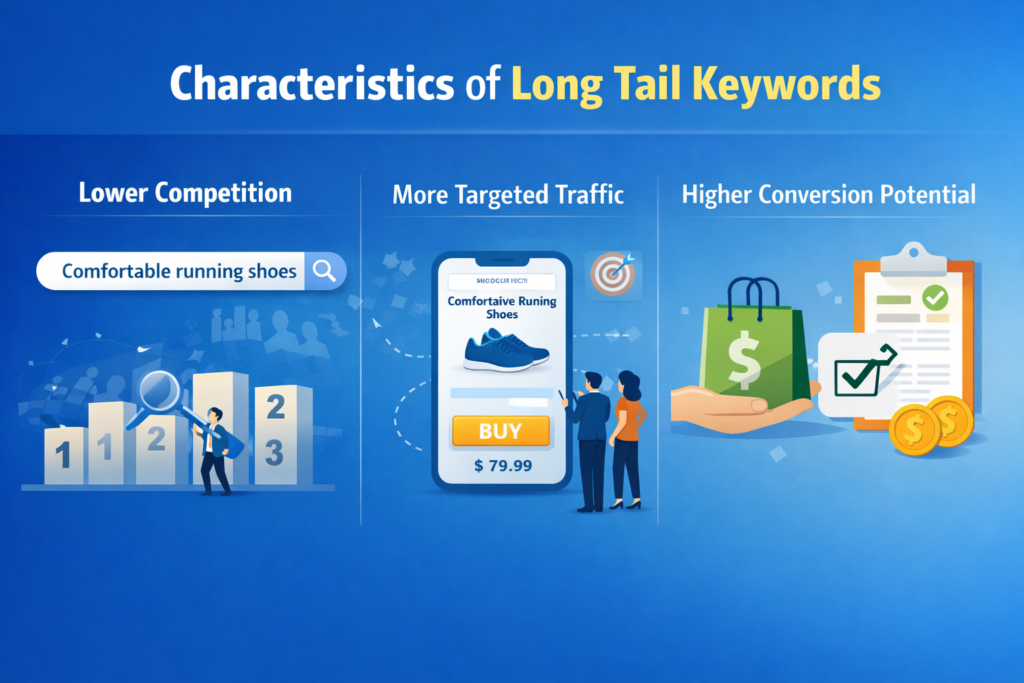
Lower Competition
Long tail keywords generally have less competition compared to short tail keywords. Fewer websites target these exact phrases.
More Targeted Traffic
Because long tail keywords are specific, they attract highly targeted traffic. Users searching these phrases often know exactly what they want.
Higher Conversion Potential
Visitors coming through long tail keywords are more likely to take action, such as making a purchase or filling out a form.
Side-by-Side Comparison of Short Tail and Long Tail Keywords
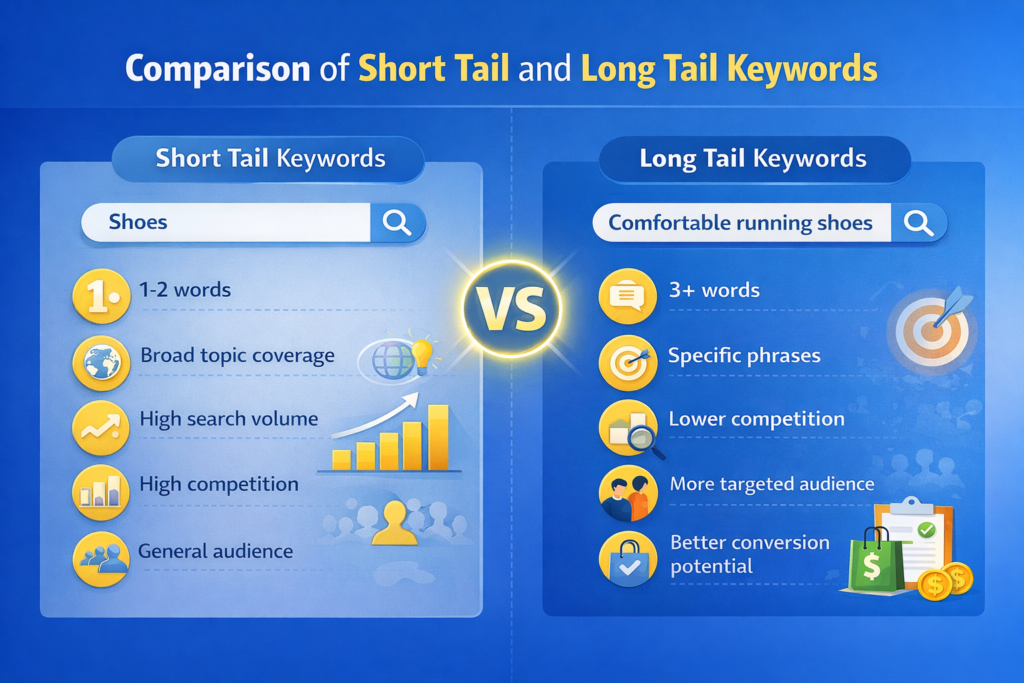
To clearly understand how short tail and long tail keywords differ in practice, let us compare them.
Short Tail Keywords
- One to two words
- Broad topic coverage
- High search volume
- High competition
- General audience
Long Tail Keywords
- Three or more words
- Specific phrases
- Lower competition
- More targeted audience
- Better conversion potential
This comparison shows that both types serve different purposes in an SEO strategy.
Practical Example of Keyword Targeting
Let us say you are targeting the keyword “shoes.” That is a short tail keyword. It is broad and competitive.
However, if your product is specifically for men’s sportswear, a better long tail keyword might be “affordable sport shoes for men in India.”
The second keyword is more specific. It clearly defines:
- The product type
- The target audience
- The location
This makes it easier to attract users who are ready to buy.
When to Use Short Tail Keywords
Short tail keywords are useful for building general awareness or ranking homepage content.
Best For Large Brands
Due to high competition, short tail keywords usually work best for large brands with strong SEO authority.
Established brands often have:
- High domain authority
- Strong backlink profiles
- Large content libraries
These advantages help them compete for broad and competitive keywords.
When to Use Long Tail Keywords
Long tail keywords are perfect for:
- Blog posts
- Niche products
- New websites
Because they are specific, they help smaller websites compete more effectively.
Ideal for Targeting User Intent
Long tail keywords focus on specific user problems or needs. This makes them ideal for content that answers detailed questions or promotes niche products.
Benefits of Long Tail Keywords for New Websites
Easier Ranking
With lower competition, new websites have a better chance of ranking for long tail keywords.
Higher Engagement
Since the traffic is more targeted, users are more likely to engage with the content.
Better Conversion Rates
Highly specific searches often indicate strong buying intent, which leads to improved conversion rates.
Combining Short Tail and Long Tail Keywords
An effective SEO strategy often combines both types of keywords.
Short Tail Keywords for Awareness
Use short tail keywords for:
- Category-level optimization
- Homepage content
- Brand recognition
They help establish a broad presence in your industry.
Long Tail Keywords for Intent-Based Targeting
Long tail keywords should target user intent and specific problems.
They are ideal for:
- Blog articles
- Product descriptions
- FAQ pages
- Landing pages
Combining both ensures balanced growth.
Step-by-Step Approach to Keyword Strategy
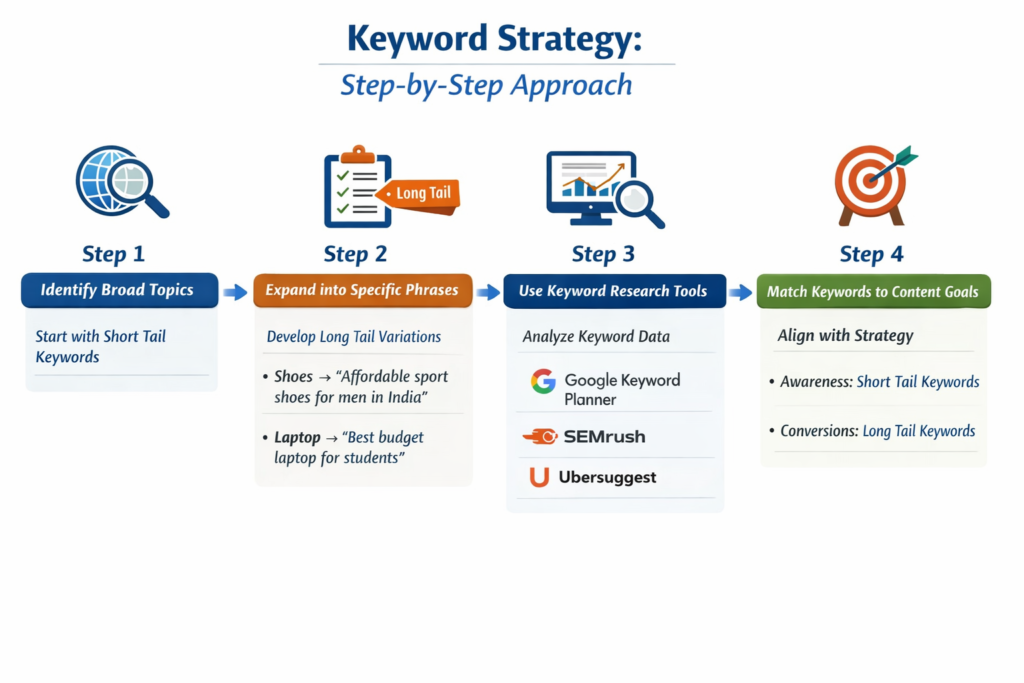
Step 1: Identify Broad Topics
Start with Short Tail Keywords
Begin by identifying broad topics related to your business. These will form the base of your keyword research.
Step 2: Expand into Specific Phrases
Develop Long Tail Variations
Take your short tail keywords and expand them into detailed phrases that reflect user intent.
For example:
- Shoes → Affordable sport shoes for men in India
- Laptop → Best budget laptop for students
Step 3: Use Keyword Research Tools
Analyze Keyword Data
To find both types of keywords, use tools like:
- Google Keyword Planner
- Ubersuggest
- SEMrush
- Answer the Public
These tools help you analyze keyword difficulty, search volume, and competition.
Step 4: Match Keywords to Content Goals
Align with Strategy
Choose keywords based on your content goal. If your goal is awareness, focus on short tail keywords. If your goal is conversions, focus on long tail keywords.
Matching keywords to your objectives improves overall performance.
Understanding Search Volume and Competition
When choosing keywords, it is important to analyze:
- Search volume
- Keyword difficulty
- Competition level
High search volume may look attractive, but high competition makes ranking challenging. Lower search volume with low competition can sometimes produce better results.
Balancing these factors is essential for an effective SEO strategy.
Short Tail Keywords: Advantages and Limitations
Advantages
- Large audience reach
- Strong brand visibility
- Suitable for homepage and category pages
Limitations
- Very competitive
- Difficult for new websites
- Lower conversion clarity
Short tail keywords help with exposure but may not always drive immediate sales.
Long Tail Keywords: Advantages and Limitations
Advantages
- Lower competition
- Higher relevance
- Better conversion rates
Limitations
- Lower search volume
- Limited broad visibility
While they bring fewer visitors, those visitors are often more valuable.
The Role of User Intent in Keyword Selection
User intent plays a major role in keyword effectiveness. Long tail keywords usually reflect clear intent.
For example:
- “Shoes” – unclear intent
- “Affordable sport shoes for men in India” – clear buying intent
Understanding what the user wants helps you create better content and improve rankings.
Final Summary: Using Keywords Wisely
To summarize:
Short tail keywords give you reach but face tough competition. They are broad and attract large search volumes.
Long tail keywords offer specificity, lower competition, and higher chances of ranking and converting.
Both have value. It is not about choosing one over the other. It is about using them wisely within your SEO strategy.
By combining short tail and long tail keywords, you can build brand awareness, attract targeted traffic, and improve conversions effectively.

Related Posts